



Makers of new app hope to transform Mandarin teaching









The perils of getting the tone wrong in a Mandarin conversation are well known; the pinyin word ma, for example, can be translated as horse, cursing, or mom, or it can be used as a suffix to indicate a question has been asked, all depending on the way it is pronounced.
Matthew Rice, after being similarly misunderstood while trying to hold a conversation, has developed a tool that he hopes will help non-native speakers get to grips with Mandarin’s tones and accents.
For Mandarin learners, achieving accurate tonal variation and accents can be a great challenge compounded by the fact that people often struggle to hear their own mistakes, so they go uncorrected.
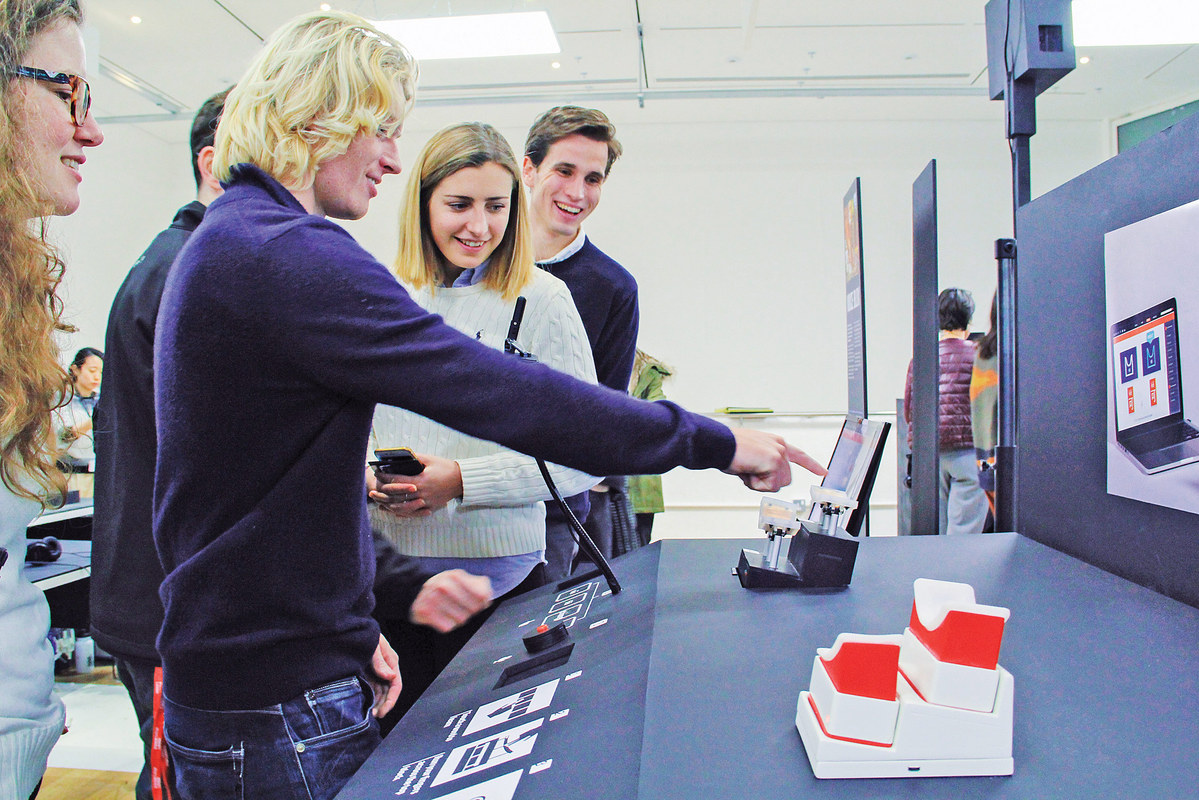
Rice, with three fellow students from Imperial College London – Gao Yang, Willa Crolius, and Dougie Mann – has designed what the teams believes is the first language learning tool that explains pronunciation as a simple physical form, allowing users to explore their accent with their hands.
“When we talked to professors and linguists, they used their fingers to show the tones for explanation,” Rice said. “Once we saw that gesture, we knew that was something we wanted to immediately start testing. We demystified tone to non-native speakers in a way that’s really intuitive because it’s so obvious to tell the difference between things that are structurally very different, like the difference between a flat block and an inclined plane.”
The device, which is called Voice Blox, takes a multi-sensorial approach to learning the language, which the team says is not currently found in physical classrooms or online.
This multimodal learning experience is based on people’s ability to directly relate sounds to body gestures, capitalizing on the close connections of the auditory and motor networks of the brain.
Rice said: “If you are relying on only your ear to decipher those small differences in tone, it becomes much more complex, so we use the medium, which is the physical world, to express more complex vocal variables, and we happen to find that tone matches quite well to structure.”
The two-block interface allows for easy live comparison between an ideal pronunciation and the learner’s own attempt. Rice said users can actively self-correct their accent by physically comparing the two block shapes, feeling and hearing themselves relative to the ideal tone.
Currently, the team has an alpha hardware prototype and an app design, with the initial tests results coming back from students and linguists proving to be promising.
The device has been chosen as one of the most exciting technology and science ventures that entered Imperial’s Venture Catalyst Challenge, an initiative that supports deep science and early-stage tech startups founded by Imperial’s students.
Finalists will battle for funding of up to 40,000 pounds ($56,000) during Imperial’s Enterprise Week on Thursday. Rice said it will be ideal if they win the prize because the team is now looking for financial support so it can manufacture its first batch of products ahead of measuring the power of the device in the classroom.
Yuan Haonan contributed to the story.




















