


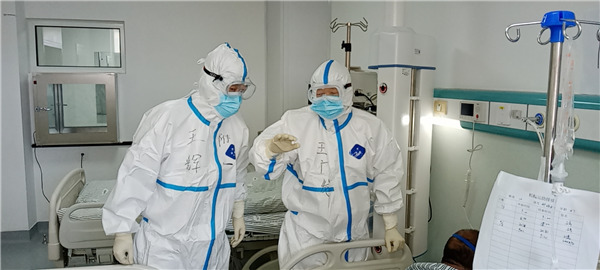
Wang Guangfa's battle with COVID-19 was different from that of other front-line experts.
From the SARS outbreak in 2003 to the Wenchuan Earthquake in 2008, and from the H1N1 swine flu in 2009 to the plague in the Inner Mongolia autonomous region last year, Wang Guangfa, a respiratory expert at Peking University First Hospital, has spent his career on the front lines.
The COVID-19 pandemic was no exception. He was in Wuhan, capital of Hubei province, as part of the National Health Commission's group of experts dispatched to the stricken city in early January. When the pandemic reoccurred in the coastal city of Dalian, Liaoning province, in late July, Wang, 56, once again packed up his gear and headed to the viral hot spot to help.
His fight against the epidemic was slightly different this time-he was, for the first time, infected on the front line.
Confirmed positive for the novel coronavirus on Jan 21, Wang spent nine days in hospital waging a personal battle against the disease as a patient, and the experience also helped him to better understand COVID-19 and how to use that knowledge to more effectively treat his patients.
Solving the puzzle
Wang arrived in Wuhan on Jan 8.The following day, he visited Wuhan Jinyintan Hospital, checking the novel coronavirus patients in the ICU. Wang helped staff at the hospital to intubate a patient.
Even though intubation is a procedure that carries a risk of infection for the doctor, Wang believed that, with his protective clothing, N95 mask, goggles and anti-spatter mask, the chance of him getting infected was slim.
On Jan 14, Wang visited the fever clinic at the Union Hospital affiliated to Tongji Medical College of Huazhong University of Science and Technology.
In the small but crowded lobby, Wang stayed for more than an hour talking to the patients.
"I was probably infected there through aerosol transmission, because the room was not well ventilated and there were too many patients in the small space. I wore a N95 mask but no protective eyewear," Wang recalls.
The head of the fever clinic who welcomed Wang also became infected with COVID-19, showing symptoms the very next day, which makes Wang more confident in his belief that he was infected at the Union Hospital while he reviewing the infection process.
Wang returned to Beijing on Jan 16 where he joined a meeting to offer feedback on the Wuhan trip with the National Health Commission on the same day.
By the afternoon, he began feeling discomfort in his left eye, which soon extended to his right. Both became red. Wang developed a fever that night, with symptoms of nasal stuffiness and a runny nose.
Wang thought he had caught the flu. He self-quarantined at home and treated himself with cold and flu medicine but, four days later, the fever had still not abated.
"The 41 cases of COVID-19 patients in Wuhan did not have symptoms on the upper respiratory tract like me, which was why I thought I had flu at first," Wang says. "Also, it was rare that I was infected through conjunctiva."





