Guge, A Lost Kingdom In Tibet
Updated: 2007-08-02 08:40
Guge was a rigidly hierarchical society. The residential area was compartmentalized depending on the social status of the people that lived there. Palaces and residences for the royal family sat on the hilltop, monasteries and houses for aristocrats sat in the middle of the hill and at the lowermost reaches of the hill were cave dwellings for ordinary people. The top position of the royal residence was to display imperial supremacy, and ensure military security.
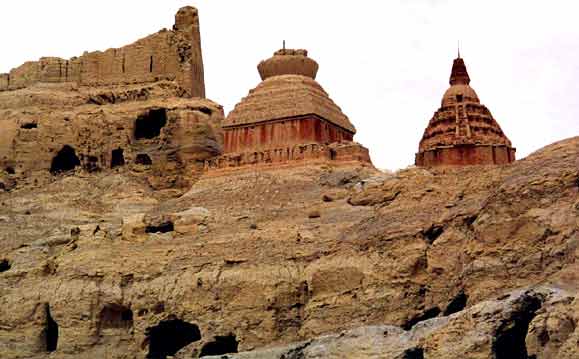
A Buddhist kingdom
Guge was established by the descendents of the royal family of the Tubo Dynasty that ruled all Tibet from about 630 to 842 AD. Tibet was called Tubo by the Han at that time. The last Tubo king arbitrarily banned the practice of Buddhism by persecuting Buddhist followers and destroying monasteries, leading to the fall of the dynasty. Being far away from Lhasa, in western Tibet, present day Ngari, proved to be a safe harbor for the persecuted Buddhists. Years later, Guge, a Buddhist kingdom, was established and was said to have a population of 100,000 at its peak.
Guge was economically advanced and famous for its industrial achievements, such as panning for gold, smelting, pottery-making, weaving, carpentry, carving, and printing.
Geographically connecting India and the hinterland of
Tibet, Guge played a significant role in spreading Buddhist doctrines. The
ruling class was fervently Buddhist and they did a lot to promote its expansion.
They invited Buddhist masters from India to spread Buddhism. A mural in one of
the surviving structures vividly depicts a Guge king warmly welcoming a visiting
Buddhist master from India. They also sent Buddhists to India to learn more
about the religion, and had Buddhist scripture translated into the Tibetan
language. A secret cave filled with remains of Buddhist scripture was found in
the ruins. Some were woodblock printed, and some were hand-written. Some were
even written with liquid gold and silver, indicating the extravagance of the
religious community of Guge.
 | 1 | 2 | 3 | 4 | 5 |  |

