


 Comments
  Print
Print  Mail
Mail  Large Medium Small
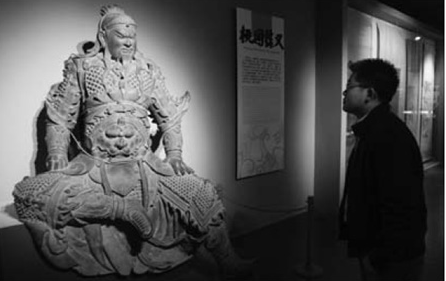
The discovery of Cao Cao's tomb has triggered a new wave of enthusiasm for not just this historical figure but also the period of San Guo, or the Three Kingdoms (AD 220-280).
An exhibition, Great Romance of the Three Kingdoms, which opened at the National Center for the Performing Arts last weekend and will run until mid-March, displays relics from the period that go back some 1,800 years.
The more than 120 articles on view represent the history of the Three Kingdoms period as embodied in its politics, economy, military and culture.
"The Three Kingdoms period has appeared in many art forms, such as Hong Kong director John Woo's epic Red Cliff, the mainland TV series Romance of Three Kingdoms adapted from a classic novel by Luo Guanzhong, paintings and even computer games. But few people know what is the real history of this period," says Yang Hong, professor and researcher at the Institute of Archaeology, Chinese Academy of Social Sciences, and senior editor of Cultural Relics.
Yang, who has been researching the Three Kingdoms period over the past half century, says the exhibited items date back to as early as the Eastern Han Dynasty (AD 25-220), a period marked by war and chaos.
Relics of the Cao family received the most attention from visitors, especially a jade suit of Cao Cao's father, Cao Song, made with 2,464 jade pieces stitched together with silver thread.
"The Three Kingdoms period lasted only around 60 years, a mere blink of an eye in terms of Chinese history, but it continues to have a dramatic impact on Chinese culture even today," Yang says.
He points out that artifacts, such as a painted pottery work showing a storyteller with a drum, and a group of bronze horses and soldiers, represent the highest level of art achieved in the Three Kingdoms period.
According to Yang, the organizers visited around 70 places over two years, to collect these relics. By early last year, 34 museums and archeological institutes across China had contributed 205 exhibits, including weapons, scripts, paintings and statues.
The exhibition was first held in Japan as a cultural exchange program organized by the Japanese Buddhist organization, Soka Gakkai. It opened in Tokyo last May and has traveled to seven Japanese cities in 10 months, drawing more than 1 million visitors.
After Beijing, the exhibition will move to Henan, the key battlefield of the Three Kingdoms period, Taiwan, and Sichuan.


Copyright 1995 - . All rights reserved. The content (including but not limited to text, photo, multimedia information, etc) published in this site belongs to China Daily Information Co (CDIC). Without written authorization from CDIC, such content shall not be republished or used in any form. Note: Browsers with 1024*768 or higher resolution are suggested for this site.
License for publishing multimedia online 0108263 Registration Number: 20100000002731