|
|||
 |
|||
|
|||
|
|||
|
|||
|
|
||||||||||||||||||
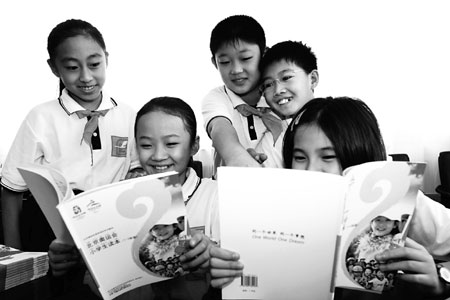
Olympic textbooks hit shelvesBy Li Jing (China Daily)Updated: 2006-11-10 08:37 What is the history of the Olympic Movement? How do you run a sports venue and manage a tournament? What events have been arranged for people with disabilities? What basic skills do volunteers need? How do you deal with emergencies?
Detailed answers to all of these questions can be found in Olympic Reader, a set of 13 books for Olympic training compiled by the Beijing Organizing Committee for the Games of the XXIX Olympiad (BOCOG). The books are set to hit the desks of BOCOG staff as well as 100,000 Olympic volunteers, millions of primary, secondary and university students, and employees in various service sectors in Beijing. Seven books from the series have already been published and are on sale. The remaining six books, including the Olympic Reader for College Students and the Olympic Reader of Oral English, are in the pipeline. Jin Huasheng, deputy director of BOCOG's Human Resources Department, said BOCOG had signed agreements with six publishers to print the books, which will sell at cost price. For example, the Olympic Reader for Primary School Students will sell for 7 yuan (88 US cents), and the other books will be priced at under 20 yuan (US$2.5) each. Nearly 800,000 Olympic Reader books have been published and sold around China already, Jin said in an exclusive interview with China Daily. The books also include a reader for BOCOG staff, for volunteers, for employees in the service sector, for general Beijing residents, and for students at different levels. It also includes a reader on Paralympic knowledge, a guide for spectators and a handbook of oral English. "The books are the fundamental materials for our Olympic training," said Jin. He is also the deputy head of the Beijing Olympic Training Co-ordination Team, which comprises various organizations and government departments. "It is the first time that BOCOG has officially compiled textbooks for Olympic training, and we are trying to make the Olympic Reader a practical and readable reference not only for BOCOG staff but also for the general public," Jin said. For instance, the Olympic Reader of Oral English, due to be published this month, has two volumes primary and advanced. They include useful words about the Olympics, about sports matches and about daily communications. "So the readers can learn how to chat with foreign visitors not only about general topics, but also specific sports issues," Jin added. The Olympic books, which were prepared by more than 200 experts and professors over the course of a year, are part of the overall Olympic training programme put together by BOCOG and government agencies. "Olympic training is a very complicated task and of great importance to the success of the Games," Jin said. He said Olympic training is divided into three levels. The first level targets Olympic staff including BOCOG employees, volunteers, national technical officials and Olympic contractors, whose number is estimated at around 200,000. The second level includes nearly 1 million people engaged in various service sectors such as public transport, healthcare, catering, tourism and retail. The third level is the largest and involves all of Beijing's general residents. The 3 million students in primary and secondary schools and universities, as well as the 3.7 million people from outside Beijing, are the major targets of this level of training. Olympic Reader is an important step in general-purpose training, which is aimed at promoting Olympic awareness and etiquette among the public, Jin said. BOCOG will team up with government departments to work out related teaching plans based on the books. "In the next step we are going to foster a batch of teachers and set up a number of training bases," Jin revealed, adding online Olympic training programmes will be available soon. Apart from general-purpose training, BOCOG is also responsible for specialized vocational training, field training at sports venues and training in rules and regulations for 200-odd different job posts at sports venues, Jin said. For instance, BOCOG has arranged 17 training sessions for nearly 1,000 people who will take up a job at BOCOG, and the committee has carried out 200 specialized training programmes since 2002. Nearly 100 BOCOG officials have been sent to different cities where large-scale sporting events were held such as Athens, Turin and Melbourne. Jin said more than 50 BOCOG officials have taken three-month off-the-job English training sessions. Nearly 70 other BOCOG officials have received free advanced English-Chinese translation training from senior language experts from the Ministry of Foreign Affairs. BOCOG itself has also launched on-the-job English training programmes for its staff. Besides, around 2,000 National Technical Officials (NTOs) have received training provided by BOCOG. "From May 2007, the major training places will be moved to the Olympic venues and the training will target various test events," Jin said. |