Official credential
 |
|
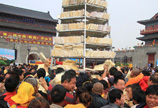
People swarm to the opening of Xun Bao, a treasure search and appraisal program on CCTV. Five appraisers from throughout the country evaluated goods for this episode of the traveling show, in Huaibei, Anhui province, in 2010. Provided to China Daily |
In 2005, for the first time, China began to promote arts and relics appraiser as a profession and to regulate the business. The next year, the Ministry of Labor and Social Security established a standardized examination for certification as an art appraiser or art evaluator.
So far, only about 40 collectors or scholars have been given the title of national appraiser. Some work at museums or at research centers, some are full-time collectors.
Various organizations have begun offering training for an appraisal certificate, although their certificates are not sanctioned by the State. "One can gain the secret skills of learning how to appraise" through a two-week program run by Grand Jiangnan in Nanjing, according to its employees' business cards. The program costs about 100,000 yuan.
"Qualified appraisers have seen tens of thousands of antiques," Song said. "That rarely can be learned through a short-term training course."
Museums look for intellectuals with master's or doctoral degrees when they are hiring, said Zhang Shuwei, curator of Beijing Art Museum. Such scholars are trained to study and maintain the cultural treasures collected by the museum and to pass the heritage to later generations, he said.
"The most credible appraisal for antique items should be done by the senior researchers at a museum," Zhang said. Museums haven't been pushed into the market in China, so their researchers can maintain their independence, he said, although it can be very difficult to find a senior researcher for hire.
The only written appraisals that are State-sanctioned are those done by forensic appraisers, Zhang said. Collectors can consider other appraisals as purely advisory, depending on the credibility of the appraiser.
Buyer beware
Some experts interviewed by China Daily warned repeatedly of the opportunity for fraud. For example, Zhang said, "Even some authoritative credentials from larger-scale organizations can be sold out."
Professional biases or self-serving motives can creep in, even unintentionally. "Sometimes because appraisers are themselves painters or collectors, they could benefit from the appraisal outcome," said Liu Shunping, deputy secretary of the China Academy of Chinese Painting who also is an artist.
There also is the possibility of mistakes by people who provide appraisals in good faith, though they lack official qualifications. Errors can be as costly as fraud.
Shi Jiandong, editor of the art collection section on sina.com, and other experts would like to see the government be more active and pragmatic in helping collectors, particularly because ordinary collectors are not well trained and access to qualified appraisers is limited. "The circle of appraisers should be well regulated," Shi said.
Meanwhile, collectors can arm themselves with information, he said. "The basic instruction is notably available online."
China's collection sector may be booming but it is far from mature, Shi said. "Trust needs building. That's the only way to develop China's healthy antique market."


Copyright 1995 - . All rights reserved. The content (including but not limited to text, photo, multimedia information, etc) published in this site belongs to China Daily Information Co (CDIC). Without written authorization from CDIC, such content shall not be republished or used in any form. Note: Browsers with 1024*768 or higher resolution are suggested for this site.
License for publishing multimedia online 0108263 Registration Number: 130349