The quest for modernity
Zhao Liman remembers how agreeable the cycling environment was back in the 1980s, given Beijing's lack of hills and the tall polars that flanked the streets.
"No trip was regarded as too long, no destination seemed too far and I never seemed to feel tired," she recalled.
 |
|
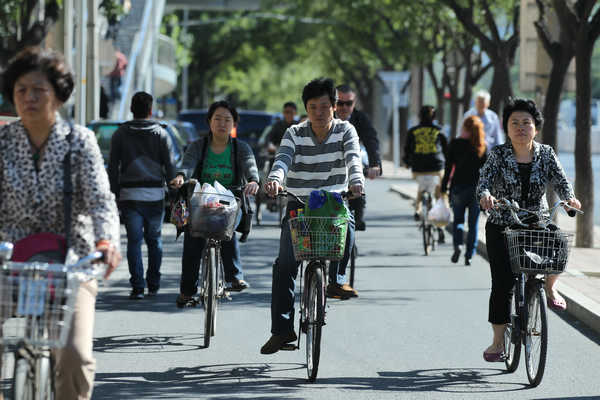
People are being encouraged to get on their bikes in Beijing and other large Chinese cities. But the use of bike lanes by car drivers has caused unease among cyclists. Wang Jing / China Daily |
Now the streets are littered with rusting bikes and it seems as if Beijing has turned its back on the bicycle in its quest for modernity.
Qin Xuelong, who opened a bike sales and repair shop in the Haidian district in 2002, rued the decline of the bike. "The number of people riding bikes was huge in the 1990s, when I first arrived," he said. "But since 2004, it seems that the number has been falling."
"When I first stayed in China between 2004 and 2006, only 15 percent of people owned a car, while the other 85 percent wanted to own one," said Shannon Bufton, an Australian architect and a co-founder of Smarter Than Cars, an NGO that aims to promote cycling in Beijing.
"Public transport seldom meets the need of the residents and with the satisfaction people feel from car ownership, there's little chance that a more sustainable lifestyle will prevail," said Zhao Jie.
In 1997, one million Beijing residents owned a car. That number had risen to two million by 2003. In 2009, car owners numbered four million, and by early 2011, the number was five million.
Riding toward the future
Qin Xuelong, the bike repairer, said he has seen a rebound in the number of cyclists in the past two years: "The thing is, people are now buying more-expensive bikes and they go cycling in the suburbs," he said.
Bufton, who owns a bike cafe in addition to his work as an architect, has plenty of Chinese patrons who like to ride in the mountains for exercise but cycle to his cafe as recreation. "A lot of people visit the hutong for dinner. They see the bikes and think cycling is cool, so they drop in for a drink," he said. "It's time that the policy makers finally turned their attention to balancing the traffic flow in cities like Beijing," said Zhang Ying, an urban planner at a Beijing research institute. "Which means the city's primary construction has finished and the planners have started looking for ways to improve the downtown area."
"The ideal model should include a life-work balance. That is, the distance between home and work should be a 45-minute commute."
Experts such as Zhao Jie of the Urban Transport Institute, suggested that people should be encouraged to walk if their journey is 1 km or less, while bikes should be used for journeys up to 3 km, and should ride the bus of their journey is longer than 5 km.
After 10 years living and working in five different foreign cities and experiencing urban environments reliant on automobiles, Zhao Liman resisted buying a car when she returned to Beijing. She is passionate about the benefits of cycling as a smart solution to urban mobility problems. "I think the government should play a leading role in changing the mode of transport. Government efforts are key," she said.
Contact the writer at zhangyuchen@chinadaily.com.cn
Mo Jingxi contributed to this story.


Copyright 1995 - . All rights reserved. The content (including but not limited to text, photo, multimedia information, etc) published in this site belongs to China Daily Information Co (CDIC). Without written authorization from CDIC, such content shall not be republished or used in any form. Note: Browsers with 1024*768 or higher resolution are suggested for this site.
License for publishing multimedia online 0108263 Registration Number: 130349