Ventilation index
China's Internet users are fond of joking that clear air in the larger cities can only be expected after gale-force winds, but University of Texas' Corsi said reliance on strong air currents to "dilute" pollution is not unusual.
"There is a term, the 'ventilation index', which is wind speed multiplied by the height of the mixed layer, meaning the atmospheric height over which pollutants can be dispersed," he said. "High winds and high mixed layer height are generally good (conditions)."
However, he pointed out that popular fantasies of artificially made winds cleansing the air are "technologically impossible because of the very large amount of air that would have to be moved".
 |
|
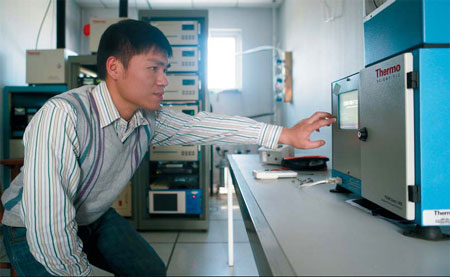
A staff member from the Dongcheng district's bureau of environmental protection in Beijing, checks a piece of equipment that tests PM2.5 at a monitoring station in downtown. Feng Yongbin / China Daily |
China's environmental agencies are already implementing methods to accelerate change, and Beijing has set a target of keeping the levels of PM2.5 below a recently established national standard by 2030, although experts said that will be a difficult task.
The new national air quality standard, unveiled by the Ministry of Environmental Protection in February, set the daily PM2.5 limit at 75 mcg per cu m, with an average annual ceiling of 35 mcg per cu m.
Officials from Beijing's environmental protection bureau have confirmed that 700,000 old motor vehicles will be banned from the city center by the end of 2015. Moreover, new standards for fuel, on a par with European Union limits, were adopted in May. Beijing's V emissions standard is expected to be unveiled by the end of the year.
The ministry has also ordered 74 cities to begin monitoring and releasing data about six types of pollutants, including PM2.5, from almost 500 national-level stations by the end of December.
Meanwhile, Guangzhou's environmental protection bureau said the city will establish a further 18 city-level PM2.5 monitoring stations by the end of the year.
The environmental departments in Beijing, Shanghai and Guangzhou monitor PM2.5 via a method called tapered element oscillating microbalance, which measures changes in the frequency of particle oscillation to calculate the weight of particles collected.
The US Embassy, which offers free public information on air quality in Beijing and Shanghai, uses a different method, which monitors the energy decay of beta rays to assess the concentration of particles in the atmosphere.
Although both are recognized as mainstream methods, the results obtained from beta ray measurements are usually at least 15 percent higher than those garnered by oscillating microbalance, according to data on the website of the China National Environmental Monitoring Center.
Emergency plan
While it is a good thing that more cities are now publishing their PM2.5 readings, the real challenge is not simply to measure airborne pollution, but to directly reduce the level of pollutants over the short term.
 |
|
Yang Xiaoguang checks monitoring equipment in Beijing as part of measures to improve air quality. Feng Yongbin / China Daily |
However, more information means people can check the readings from their closest monitoring station and take appropriate action, according to experts at the Beijing Municipal Environmental Monitoring Center.
If outdoor activity is unavoidable, specially designed masks may help block the tiny airborne particles, said Ma Yongliang, a researcher specializing in the prevention of air pollution prevention at Tsinghua University's School of the Environment.
Yu, from the Beijing Environmental Protection Bureau said that a plan for heavily polluted days is currently being formulated and will be released soon.
Chen Tian, the bureau head, told Beijing News that whenever circumstances require, the plan will be activated and physical education may be halted in primary and middle schools and the use of governmental cars in Beijing suspended.
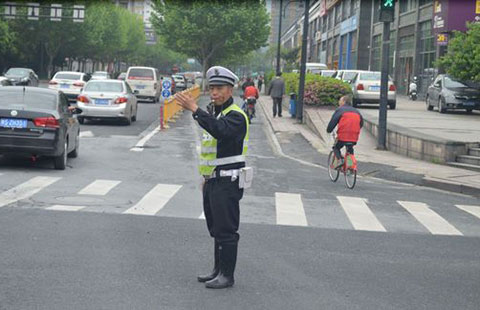
Automobile exhaust contributes more than 20 percent of the capital's air pollution. In an attempt to reduce traffic levels and therefore emissions, Beijing's transportation bureau is assessing a plan to restrict car use in the city to alternate days, and to specific times in certain areas, depending on whether the final digit on the vehicle's license plate is odd or even, according to a report published on Oct 15.
The situation is a classic problem, one that the US, United Kingdom, and European countries faced 50 or more years ago, according to Corsi of the University of Texas.
He said those countries solved the problem by imposing strict controls on industry. "But it took one or two decades to really get everything under strict control. This type of change rarely happens overnight."
Contact the reporters at wuwencong@chinadaily.com.cn, jiangxueqing@chinadaily.com.cn and qiuquanlin@chinadaily.com.cn


Copyright 1995 - . All rights reserved. The content (including but not limited to text, photo, multimedia information, etc) published in this site belongs to China Daily Information Co (CDIC). Without written authorization from CDIC, such content shall not be republished or used in any form. Note: Browsers with 1024*768 or higher resolution are suggested for this site.
License for publishing multimedia online 0108263 Registration Number: 130349