Who guards the green guards?


 |
|
Children from a primary school in Longling county, Yunnan province, introduce endangered fish into the Jinsha River near the Xiangjiaba hydropower project, which borders Longling in Yunnan and Yibin in Sichuan province. [Zeng Lang / for China Daily] |
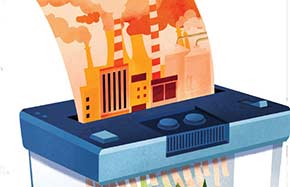
The system tasked with safeguarding and assessing the possible environmental damage caused by infrastructure and construction projects is outmoded and badly in need of reform, as Wu Wenchong and Jiang Xueqing report from Beijing.
'Smog" and "haze" have become buzzwords this winter after severe air pollution choked China for several weeks. Equally severe are the country's polluted surface water, ground water and farmland soil. In the face of the worsening levels of pollution, experts have blamed the problem on the disorderly discharge of all kinds of fumes and waterborne waste. They come from factory processes and emissions as well as auto exhausts, during China's 20-plus years of rapid industrial development.
The laws and regulations, which date to the 1970s, were designed to tackle much lower levels of environmental pollution, and now insiders say that only the Environmental Impact Assessment system - tasked with assessing the potential environmental risk posed by any given project before construction begins - has the ability to be the first line of defense against pollution.
However, many experts believe that the system, instigated with the intention of preventing pollution before it can occur, no longer serves the purpose for which it was established, because the pass rate of projects under assessment is almost 100 percent.
Experts said the key problems are that the EIA agencies are paid by project owners, who only care about getting their projects passed, and that the evaluations only begin after the type and scale of a project have been formulated by other government departments.
They have suggested a number of ways the system can be reformed: Ironing out the legal flaws related to the collection of public opinion; ensuring that the EIA agencies are entirely independent of the departments that supervise their reports; and placing greater emphasis on the assessment of regional development plans, rather than on individual projects.
In January, 88 EIA-qualified agencies were publicly admonished by the Ministry of Environmental Protection. They accounted for 18 percent of the 500 agencies whose activities were examined by the ministry between June and October last year.
Two agencies had their EIA qualification canceled and a further eight saw the range of their qualification reduced. The other 78 were ordered to rectify and improve their performances within a specified period.
The investigation uncovered a number of problems, including the poor overall quality of both agency personnel and the assessment documents they produced. More worryingly, some agencies were discovered to have included inaccurate data in their assessments.
The ministry's move was seen as a signal of the government's determination to purge the chaos within the EIA system. Nationwide, there are approximately 1,170 agencies; 190 of them are classified as Grade A, while the others are Grade B.
An agency's grade is determined by the number of EIA engineers it employs: Grade A agencies write assessment reports on projects that can only be approved by the ministry itself, and Grade B agencies write reports about much smaller projects, those approved by environmental departments at provincial level, said Wang Shoubing, an EIA engineer at Fudan University in Shanghai.
Related:
- Environmental damage presents costly economic bill
- Uncontrolled permits do environmental damage in Indonesia
- Beijing Municipal Bureau of Environmental Protection
- Environmental protection is important
- Amend the Environmental Protection Law correctly
- China launches census on environmental protection
- Draft law stresses govt role in environmental protection
- Govt to play bigger role in environmental protection
- Environmental protection urged amid economic slowdown