|
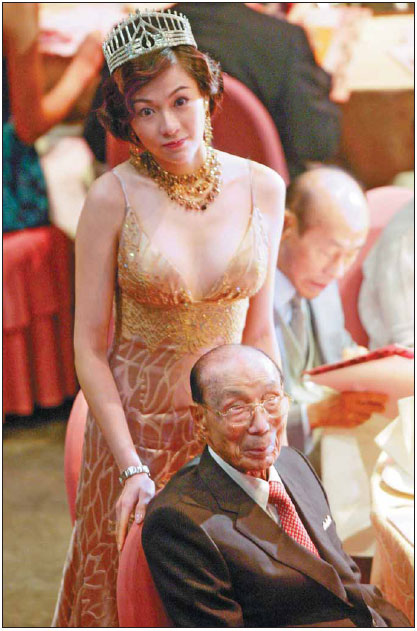
Miss Hong Kong Pageant 2005 1st runner-up Sharon Luk poses with Run Run Shaw, veteran producer and founder of Shaw Brothers Studio, at the Miss Hong Kong Pageant 2006 in Hong Kong. The pageant, which became a permanent TV fixture in 1973, is one of the Hong Kong institutions spawned by TVB. Paul Yeung / Reuters / Files |
Shaw reached a compromise with MP&GI in March 1963. Three months later, Loke Wan Tho, the owner of MP&Gi, and his lieutenants were killed in an air accident in Taiwan, essentially leaving the Shaws as the only major players in the Hong Kong film industry.
Run Run Shaw started two trends that left indelible imprints on Chinese-language cinema by grooming two unknown genres into pioneers and giants. The first was female-dominated musicals, with Diau Cham (1958) as his opening salvo. Director Li Han-hsiang took two strands, traditional Chinese opera and the Hollywood musical, and fused them into a unique genre that swept the Chinese-speaking world (other than the Chinese mainland, which remained closed to all imports, apart from a handful of government-controlled productions).
When the musicals started winding down in the late 1960s, Shaw gave a directorial opportunity to the erstwhile film critic Chang Cheh to make the kind of movies he had dreamed of. The result was a spate of martial arts films, starting with One-Armed Swordsman (1967), which were so revolutionary they completely upgraded the genre, and the ripple effects are being felt even today.
Studio system
Shaw followed a studio system that employed talent at a time when the Hollywood studio system was disintegrating and beginning to use agency-based talent. He signed long-term contracts with newcomers, but refused to let them share the profits from huge hits. This strategy helped him to control costs but was also the cause of major talents, such Li Han-hsiang, leaving him - after Li had found fame. Shaw sued, but when Li failed to launch his own film business in Taiwan, Shaw took him back, a move uncharacteristic of Chinese employers.
As the global film industry moved away from the rigid employment system, Shaw's way of doing things resulted in missed opportunities and the loss of many talented individuals. When Bruce Lee returned to Hong Kong to begin his film career, he approached Shaw first and asked for $10,000 for a picture. Shaw wanted to reduce the actor's fee by 75 percent, and he was offended that an untested newcomer had the chutzpah to name his own price. In an about turn, Lee joined another studio, Golden Harvest, which had just been founded by Raymond Chow, a long-time Shaw lieutenant. The rest is history.

Copyright 1995 - . All rights reserved. The content (including but not limited to text, photo, multimedia information, etc) published in this site belongs to China Daily Information Co (CDIC). Without written authorization from CDIC, such content shall not be republished or used in any form. Note: Browsers with 1024*768 or higher resolution are suggested for this site.
License for publishing multimedia online 0108263 Registration Number: 130349