|
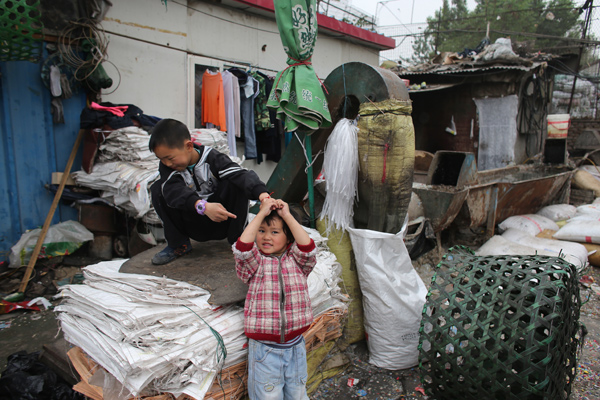 |
| Children play amid recycled materials near their house. |
Huang was referring to the time when China's economy was growing at breakneck speed and large parts of Beijing were transformed into giant construction sites.
"All the hectic building created vast amounts of construction and industrial waste - metal, wood and plastic - which we purchased in bulk and sold to the little recycling factories that are scattered all over neighboring Hebei province."
The recyclers also bought from waste-collectors who stationed themselves outside numerous gated residential neighborhoods to offer meager sums for items the locals either no longer wanted or had no use for - ranging from empty bottles and old newspapers to used furniture and household appliances, and, almost inevitably, air conditioners.
"We cleaned and repaired the ones in relatively good condition and then sold them, directly and through middlemen, to people who were keen to buy secondhand stuff at a customer-friendly price," said Huang, a 41-year-old father of two. "Items beyond salvage were only valuable as raw materials. They probably ended up in those recycling factories, some transported by the freight trains that had previously carried coal and vegetables from Hebei to Beijing."
End of the good times
The upswing ended abruptly with the 2008 global financial crisis. Construction work stopped, people spent carefully and discarded cautiously, and buyers refused to accept as much raw material as before. As a result, prices began to fluctuate, sometimes violently, making what was once a risk-proof business a volatile proposition.
Despite the downturn, many residents stayed in Dongxiao-kou, often because there was no viable alternative. Now, though, they have to leave and the sense of anxiety is palpable.
However, according to Wang Weipin, who has spent the past three decades trying to infiltrate the little-known and even less-understood world of the garbage collectors and traders, the residents are simply bowing to the inevitable. The expansion and redevelopment of the city meant they were always likely to be displaced sooner or later.
"Theirs is both a world and an underworld, with its own set of thorny problems," Wang said. "In the early days, those who failed to collect enough trash frequently resorted to stealing, and between them may have snatched more than a few hundred drain covers, despite the risks posed to unwary pedestrians."
The village has also been targeted by those who say the residents' "unhygienic" operations are a source of pollution and, potentially, disease.

Copyright 1995 - . All rights reserved. The content (including but not limited to text, photo, multimedia information, etc) published in this site belongs to China Daily Information Co (CDIC). Without written authorization from CDIC, such content shall not be republished or used in any form. Note: Browsers with 1024*768 or higher resolution are suggested for this site.
License for publishing multimedia online 0108263 Registration Number: 130349