 |
|
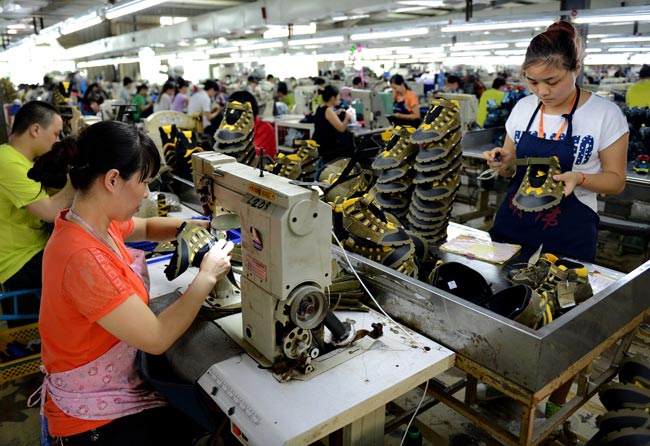
Migrant workers at a shoe factory in Jinjiang, Fujian province in June. Jinjiang has more than 1.3 million migrant workers. ZHANG GUOJUN / XINHUA |
But the friendly locals and warmhearted colleagues soon made Wang believe he was not an "outsider".
Wang said he is grateful to his company that organizes activities such as training programs and leisure trips. It also offers counseling services to migrant workers in case they suffer from stress and anxiety.
|
Raising standards Local authorities of Jinjiang, a city that has played a pioneering role in pushing forward human-centered urbanization, has pledged more proactive moves in urban-rural development. Jinjiang Mayor Liu Wenru said that despite the achievements the city has made in accelerating urbanization, the quality of development should still be improved. "The living standards of urban residents should be raised to enhance the sense of belonging of migrant workers who have become a part of the community," Liu said. He added that the infrastructure and public services of some rural areas remain underdeveloped and needed to be improved. Chen Rongfa, Party chief of Jinjiang, said the government will keep working on the policies related to residence permits to further lower the restrictions on household registration and optimize public services. The government will improve the service functions of small towns and pursue better ecology, cleaner air and safer drinking water, Chen said. In 2006, the Jinjiang city government became the first of its kind in the country to officially make three promises to migrant workers to improve their lives. It promised that no migrant worker would suffer from salary arrears; no migrant worker's children would drop out of school; and no one would have his or her rights and interests breached. In 2011, Jinjiang also became the first city in Fujian province to issue residence permits allowing holders to access 30 aspects of welfare benefits covering education, medical care and housing. In 2012, the city eased the restrictions on hukou or household registration. Migrant workers with residence permits who stayed in the city for two years (or stayed in rural areas for one year) could apply for the registration. Previously, only those who stayed in the city for five years and signed a minimum three-year employment contract with companies could register their households. . |
Wang is particularly grateful for the matchmaking activities organized by the city's federation of trade unions because he met his wife through them.
"To many migrant workers, loneliness is the biggest challenge. The matchmaking activities are a considerate move to help workers make new friends and meet potential partners," Wang said.
Wang married his wife, who is from the same village, in 2006 at a group wedding of 100 couples organized by the local government. The couples were all migrant workers, and the event was the first of its kind in Jinjiang.
"I'll never forget the wedding. I was surrounded by flowers and colorful ribbons, and everyone wished me happiness," Wang said.
Wang also decided to register as a permanent resident of Jinjiang because he planned to have a baby. The registration meant he would not have to return to his hometown to prepare the paperwork.
"There are no barriers in household registration. As long as you lived or worked in the city for two years, you can register," Wang said, adding that he did not have to buy a house to provide an address for the registration because he could use the company dormitory to do so.
"I'm glad to become a true Jinjiang'er," Wang said.
Protecting homes
The local government is also preserving the local areas of Jinjiang amid the rapid urbanization and integration of new residents.
Zhuang Gaofeng, 75, a local resident of Jinjiang, is pleased to see familiar surroundings being maintained.
Local authorities designated the downtown area where Zhuang used to live as a traditional district, a project that has relocated and renovated more than 100 traditional Song Dynasty (960-1279) and Ming Dynasty (1368-1644) buildings.
When he got wind of the project, Zhuang worried that his house of more than 200 years would be demolished and he would be settled to a place far from downtown.
Zhuang said generations of his family have been living in their 200-square-meter house. He had even prepared to appeal to the authorities to protect his home.
But staff involved in the project met and spoke with original residents of the area. They told Zhuang the house would not be demolished. Instead, it would be added to the project's list of protected buildings.
Zhuang said he will be resettled in a "fancy residential compound" nearby, 10 minutes' walk from his original house.
"The new place the government arranged for my family is in the prime location of the city. It is convenient with a nice view, I have nothing more to ask for," Zhuang said.
Chen Rongfa, Party chief of Jinjiang, said the local government has been adopting a people-oriented approach in its rebuilding and relocation projects.
Before any demolition, the government will consult residents and consider their opinions, Chen said.
"The best parts of the city were not used for 'lucrative' projects. They were used to resettle the people. That proves that the people's livelihoods matter and they are put first," Chen said.
Contact the writers at sunli@chinadaily.com.cn
 |
|
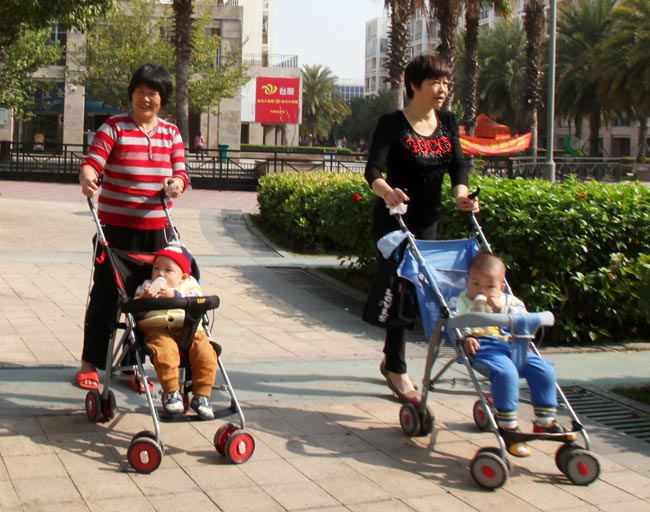
Residents of Xingfukangcheng neighborhood in November 2012. Jinjiang relocated residents to its prime areas in its urbanization drive. XU WEIGENG / FOR CHINA DAILY |

Copyright 1995 - . All rights reserved. The content (including but not limited to text, photo, multimedia information, etc) published in this site belongs to China Daily Information Co (CDIC). Without written authorization from CDIC, such content shall not be republished or used in any form. Note: Browsers with 1024*768 or higher resolution are suggested for this site.
License for publishing multimedia online 0108263 Registration Number: 130349