The Beijing government is considering extending the household registration system, or hukou, to nonnatives who fulfill certain criteria. Although many have welcomed the proposal, the capital's migrant workers fear they will miss out. Xu Wei reports.
The distance between Liu Chaoyang's home in Beijing and his son's primary school is 270 kilometers, even though the closest school is just 200 meters from his front door.
The 43-year-old migrant worker is paying the price for not having Beijing hukou, a household registration certificate, even though he has lived and paid tax in the capital for more than 12 years.
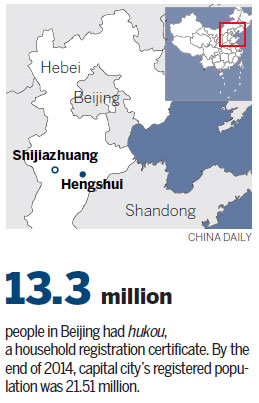
Every month, Liu drives his 6-year-old son from their home in the Yizhuang district to a boarding school in Hengshui, Hebei province, a journey of at least two hours.
"I have no other options because I do not have Beijing hukou. Last year, I made great efforts to register my son at a primary school, but I was unsuccessful," he said.
In China, school-level education, medical care, real estate assets and vehicle purchases are usually reliant on hukou status, especially in major metropolises such as Beijing, Shanghai and Guangzhou, Guangdong province.
Without a household registration permit, Liu must provide more than just the basic paperwork to get his son into a school - the extra qualifications include proof that at least one parent is employed in the same district as the school and that at least one parent has paid social insurance contributions in the district for at least six months.
"But I live in one district and work in another, which means there's no hope that my son can attend a school in either of them," he said.
Liu is not the only parent who has been forced to bite the bullet and send their child to the boarding school in Hebei; about 800 of the students come from migrant-worker families in the capital, and none of them has Beijing hukou.
According to the Beijing Municipal Bureau of Statistics, by the end of 2014, the capital had a registered population of 21.51 million, a rise of 368,000 from the previous year. Of those 21.51 million, 13.3 million had hukou status, a jump of 171,000 from 2013.
Now, the capital is considering introducing a new system to allow nonresidents to obtain hukou by gaining credit points, but Liu said he has little hope of achieving residential status under the new system.
According to a draft regulation released in December for public discussion, the criteria for obtaining Beijing hukou include having a valid resident's permit, which has less legal force than hukou, and applicants must be younger than 45 years of age. Candidates must also prove that they have paid social insurance in the capital for at least seven consecutive years and that they don't have a criminal record.
However, the draft regulation gives priority to those with strong educational backgrounds. Although the bar is set at different levels for different occupations, applicants with a bachelor's degree will be awarded 15 points, while those with a doctorate will be given 39 points. "I'm already 43, and I only have a bachelor's degree. I don't think I will qualify under the new system," Liu said.

Copyright 1995 - . All rights reserved. The content (including but not limited to text, photo, multimedia information, etc) published in this site belongs to China Daily Information Co (CDIC). Without written authorization from CDIC, such content shall not be republished or used in any form. Note: Browsers with 1024*768 or higher resolution are suggested for this site.
License for publishing multimedia online 0108263 Registration Number: 130349