



Mei Lanfang









|
Born: October 22, 1894 Died: August 8, 1961 (aged 66) Occupation: Political Party: Communist Party of China (joined in 1959) |
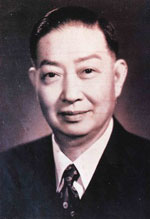
Mei Lanfang, Male, Han nationality, was a Chinese theatrical performer and is recognized as one of the greatest singer-actor-dancers in Chinese history.
Mei Lanfang is his stage name, and in Chinese it is generally considered a feminine name. His real name was Mei Lan.
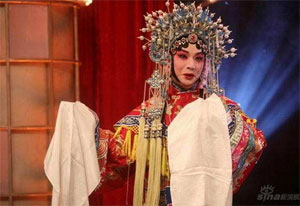
The son and grandson of noted opera singers, Mei began studying the Peking Opera at age 8 and made his stage debut at 10, playing a weaving girl. Thereafter he played mostly female roles, becoming especially known for his portrayal of the "Flower-Shattering Diva"; his style of dance won such acclaim over the years that it came to be known as the "Mei School". At age 13 he joined the Xiliancheng Theatrical Company and, through performances in Shanghai and elsewhere, acquired a national reputation.
Some of his most famous roles are Bai Niangzi in Duanqiao ("Broken Bridge"), Lin Daiyu in Daiyu Zanghua ("Daiyu Buries Flowers"), Yuji in Bawang Bieji ("Farewell My Concubine"), and Yang Yuhuan in Guifei Zuijiu ("Concubine Gets Drunk").
Mei was the first artist to spread Peking Opera to foreign countries, participating in cultural exchanges with Japan, the United States, and other regions. He toured the world, forming friendships with the western contemporaries of his day, including Charlie Chaplin.
He toured Japan in 1919, 1924 and 1956 and the United States in 1930. While in the US, he visited Hollywood, where he was welcomed by Douglas Fairbanks and Mary Pickford. In 1935 and 1952, Mei toured Europe, playing to appreciative audiences in Berlin and Moscow. Seeing Mei perform especially impressed the German playwright Bertold Brecht and influenced his concept of the alienation effect.
After the outbreak of the War of Resistance against Japanese Aggressioin, he settled in Hong Kong (1938), but he returned to Shanghai in 1942 following the Japanese seizure of the territory and withdrew from the theatre for five years, resuming his career only in 1945. Thereafter he did both stage and film work and served as director or member of several cultural organizations. He joined the Chinese Communist Party in 1959.
After 1949 he served as director of China Beijing Opera Theater, director of the Chinese Opera Research Institute, and vice-chairman of China Federation of Literary and Art Circles.
Besides his autobiography, Forty Years of Life on the Stage, several of his articles and essays have been published in The Collected Works of Mei Lanfang. Recordings of his best-known performances have been published in A Selection of Peking Operas Performed by Mei Lanfang. In 2000, the story of his life was filmed in a documentary entitled The Worlds of Mei Lanfang. Acclaimed director Chen Kaige directed Forever Enthralled, a film biography of Mei's life, released in December 2008.


- Chinese researchers design fresh strategy to boost solar cell performance
- China successfully launches new communication technology test satellite
- Plan to widen public services access
- Rights of over-age workers protected
- China unveils its first open-source AI model for crop protection
- Guangdong to boost sci-tech innovation





