



Protecting unique natural assets on rooftop of world









From snow-capped mountains to crystal clear lakes, the Tibet autonomous region is known for its spectacular natural environment.
In a bid to safeguard this important resource for future generations, more than 8.4 billion yuan ($1.2 billion) has been invested in ecological protection in the region during the past eight years.
This money has been spent on implementing an approval system to prevent any illicit mining or exploitation of the region's resources and introducing a program that encourages residents to get involved with the creation of about 7,200 positions for part-time wildlife and environment monitors under the Tibet Forestry Department.
The regional government's aim is to act before environmental degradation occurs, because remedial work after the fact is almost always more complicated and expensive.
"Prevention is our top priority and the best form of environmental management," said Tsering Yangzom, deputy head of the region's department of environment protection.
In addition to Tibet's landscapes and waterways, the regional government also focuses on protecting its abundant glaciers.
According to official statistics, the region has nearly half the glaciers in China - 22,468 to be exact, covering an area of more than 28,645 square kilometers.
"Tibet is very young, geologically speaking, and has some of the most developed glaciers in the world," said Tenzin Lhundrup, the region's deputy Party secretary.
"Since ancient times, Tibetans have called their home 'snow land' with good reason."
A statement that was recently issued by the region's new chairman "reflects a new and deeper understanding of the importance of Tibet's ecological conservation", Tenzin said.
"It encompasses all the geographical features of the Tibetan plateau."
A number of positive achievements have been recorded since the regional government's protection plan was instigated, according to its environmental protection department.
Lhasa successfully ranked as a national model city for environmental protection in 2014 and the Tibetan cities of Shannan, Nyingchi and Xigaze were all included in the nation's first batch of trial ecological civilization demonstration areas.
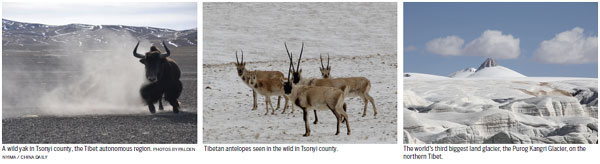
Official statistics show some of the species endemic to the region have been recovering as well, with the number of Tibetan antelopes increasing from about 60,000 in 1995 to more than 200,000 in 2014.
The wild yak population has also increased to about 20,000, while there are about 8,000 black-necked cranes, up from no more than 2,000 in the past.
Contact the writers at palden_nyima@chinadaily.com.cn
(China Daily USA 02/24/2017 page5)


Today's Top News
- Renewable Energy Law country's green transition spur
- Xi exchanges congratulations with Egyptian president on 70th anniversary of ties
- Govt pledges to tackle pollution at local levels to build Beautiful China
- Importance of basic research stressed
- New theory promises to transform chip sector
- Experts urge upholding Tokyo Trials' outcomes





