



Calls rise to make Chinese firms' outbound investments rational









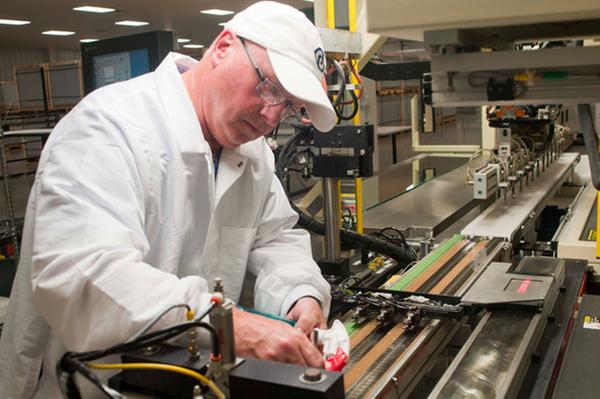 |
| A Wanxiang Group worker assembles solar panels at a factory in Elgin, Illinois. Wangxiang Group is an auto parts manufacturer and clean energy provider based in Hangzhou, Zhejiang province. [Photo/Xinhua] |
BEIJING-Chinese companies' outbound investments might have raised their global profile, but have yet to fully alleviate fears of a capital flight, experts said.
For many years, inbound foreign direct investment, or FDI, was important for China's exports and the growth of an economy that was labor-rich but capital-poor. Now, outbound direct investment, or ODI, exceeds inbound FDI.
In 2016, the balance tilted further toward capital outflows. Non-financial ODI jumped 44.1 percent to $170 billion, outstripping inbound FDI by more than $50 billion, with Chinese investment finding its way to 164 countries and regions.
But experts said that not every investment project makes immediate sense where, for example, a steel maker acquires a food company overseas.
"China has always encouraged overseas investment, but more needs to be done to ensure it occurs in a more rational manner," said Pan Gongsheng, head of the State Administration of Foreign Exchange.
Some companies with high levels of debt have borrowed money to invest overseas, and others have tried to transfer assets overseas in the name of outbound investment, Pan noted.
China has accumulated the world's largest stash of forex reserves. After the decline of the forex stockpile from a peak of around $4 trillion to below $3 trillion in January, regulators moved to crack down on illegal cross-border capital flows while reiterating that normal business would not be affected.
Commerce Minister Zhong Shan last month blamed the surge in outbound investment on what he called febrile emotions, saying some "blind and irrational" investments required more regulation.
"Authorities are improving verification and compliance in overseas investment, but irrational outbound investment is a serious issue in real estate, hotels, film-making, entertainment, sports and other sectors," said Ren Gulong, a partner at Beijing's Anjie Law Firm.
"Acquisitions of targets larger than the Chinese buyer and targets not related to the buyers' main businesses are also likely to be affected," said Ren, who is seasoned in overseas mergers and acquisitions.
China's central bank governor Zhou Xiaochuan last month criticized overheated and hasty outbound investment in industries such as sports and entertainment, which do little for China's economy.
Market observers have seen some projects terminated as investors failed to demonstrate they were genuine and reasonable.
Zhou Chao, vice-president of the China-Africa Development Fund, said that despite speedy growth of the fund's investments, it had never had trouble moving money out of China, as all of their projects had passed authenticity and compliance checks.
That view is echoed by Anjie Law Firm's Ren. He said he has encountered few problems with projects in sectors conducive to industrial upgrading such as high-end manufacturing, high-tech sectors, energy saving and environmental protection.
Pan Gongsheng, head of the State Administration of Foreign Exchange, said: "Overseas mergers and acquisitions can be like a bunch of roses: they can prick with their thorns. Companies need to carry out thorough due diligence."
Analysts have noted the rapid expansion of speculative investment.
"The emergence of speculative cases has grown at around the same rate as outbound investment itself," said Sun Lijian, director of the financial research center at Fudan University, adding that only timely supervision could curb some "curious" investments.
ODI in non-financial sectors during the first two months this year dropped 52.8 percent from last year, with more money flowing to manufacturing, IT and software sectors.
Companies must keep calm when facing the overseas investment mania, and focus on technology, brand building and market access, cautioned Yang Bin, at the Chinese Academy of Social Sciences.











