



Prospering by preserving a time-honored craft









Many Tibetans consider it a luxury to drink tea from a traditional silver-plated wooden bowl. Yet few know where these bowls are made - in the Tibet autonomous region's lowlands, such as eastern Nyingchi prefecture.
Buying an authentic handmade Tibetan bowl today is not cheap, partly because there are fewer and fewer artisans left that make them.
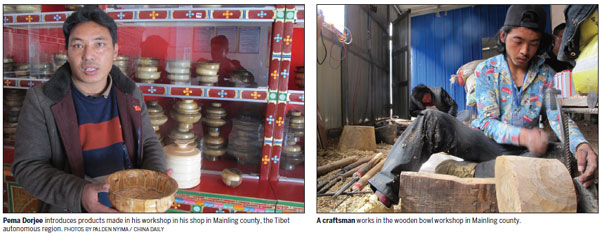
But in this scarcity there is opportunity - something that Pema Dorjee, a village leader from the Aorong township of Mainling county, realized during a fact-finding trip he went on that was organized by the county last year.
"Most people know that traditional bowl making is a craft that urgently needs preserving, but few want to be involved if they cannot benefit economically," said the 40-year-old.
It takes a great deal of patience and skill to craft a traditional Tibetan bowl, and before last year no one in Pema's village had the expertise required.
So he spent 140,000 yuan ($20,300) bringing in seven experts from Gyaca county, Shannan prefecture, to stay in the village for six months and impart their knowledge.
They helped set up a workshop that now employs five craftsmen, who each receive a monthly salary of 2,000 yuan.
It also operates as a cooperative, generating 3,000 yuan per year in revenue for 14 of the village's most impoverished families.
The workshop produces wooden bowls for use with butter tea, sweet tea and noodles, as well as containers to hold roasted barley flour, cheese, butter and snacks.
A tea bowl costs between 30 and 50 yuan, and a box to hold tsamba, roasted highland barley powder, costs about 150 yuan. The most expensive product made in the workshop sells for 6,000 yuan.
The goods are sold to neighboring villages and employees from local construction sites, as well as through a large shop in Lhasa, the region's capital.
Pema actively promotes the workshop's wares on social media and is hoping a new range of designs, featuring symbolic patterns, will sell well.
Ogyen Dondrup, 39, is one of the workshop's craftsmen.
"I have been learning the skills required for almost one year and it was very tough at first, but slowly, I have gotten to grips with it," he said.
"In the past, I did not have a stable job. I collected herbs in the summer, and my average annual income was only 10,000 yuan, but with this new job, my income has increased to more than 20,000 yuan a year."
Pema now plans to conduct further training courses, so that the workshop's craftsmen can learn new ways of decorating their products.
"I am pleased to see young people learning a new craft that will benefit their family, and I am also pleased that my fellow villagers can now have their favorite wooden products made right on their doorstep," he said.
(China Daily USA 04/14/2017 page5)


Today's Top News
- Renewable Energy Law country's green transition spur
- Xi exchanges congratulations with Egyptian president on 70th anniversary of ties
- Govt pledges to tackle pollution at local levels to build Beautiful China
- Importance of basic research stressed
- New theory promises to transform chip sector
- Experts urge upholding Tokyo Trials' outcomes





