



Could Japan end China's ping-pong supremacy?









"Hirano was dominating the entire match over Chen Meng, and her techniques are indeed more advanced than ours," confessed China's women's team coach Kong Linghui.
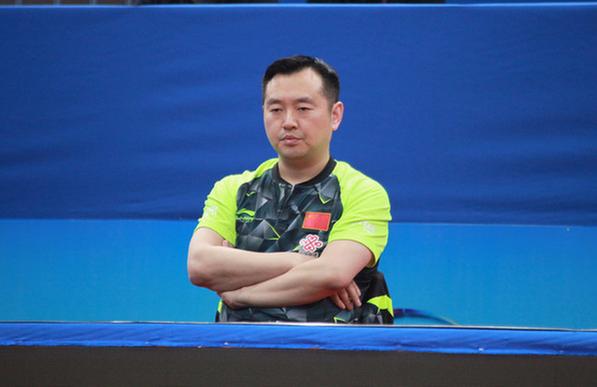 |
| Chinese women's team coach, Kong Linghui, has much to ponder as his team suffer a string of unexpected defeats at the ITTF Asian Championships in Wuxi.[Photo/ chinadaily.com.cn] |
With more than three years left until Tokyo, China may need to up its game if it is to hang on to its Olympic ping-pong crown.
"We saw now the beginning of this new generation coming up, and they have now nearly four years to get prepared for this big event," said Brand. "If they continue to do their job, it's a big, big challenge for China."
"Heading toward the Olympics in Tokyo in 2020, I think the Japanese are on track to be very competitive," agreed Bruce Burton, executive vice-president of the International Table Tennis Federation. "And I think that will make it much more exciting, of course."
According to Ian Marshall, editor at the ITTF, China will need to up its game to maintain its supremacy over its new rival, as Japan has chipped away at the historical advantages that the country has relied on.
"China has a huge base of players, now Japan is following the same principle. Like China, they have a state-of-the-art training center and more than ever there is competition for places so the level rises," explained Marshall. "China cannot be complacent."
Ironically for China, this Japanese revolution has largely been made in China. As the leading force in the game, the country not only acts as a model for others to follow, but also plays an active role in helping other nations develop.
"The Chinese are quite supportive of assisting other countries to develop. They welcome other countries' coaches to come here to train, other countries' players to come here to train. It's very important to have these exchanges of best practices," said Burton.
"China has sent so many table tennis coaches and professionals to Japan, helping them develop," agreed Wang Rui, Japan's women's team coach, who is Chinese himself. "I think it's fair to say that a Japanese paddler's success must have something to do with the Chinese."
But after the wake-up call in Wuxi, Chinese table tennis finds itself in the unfamiliar position of needing to learn from another country's strategy.
"We do need to learn from the other associations, including the Japanese, who do an excellent job on youth training," said head coach Liu. "It's just an alarm bell from our opponents warning us to be more aggressive and creative."


Most Popular
- Liaocheng hosts 160 athletes at Asian university dragon boat contest
- China's cold climb to winter sports peak
- 2026 ASICS tennis junior tour held in Shanghai
- Chinese snooker on cue for global dominance
- Borodachev and Batini win gold at FIE Foil Shanghai Grand Prix
- DPRK sports delegation arrives in ROK