



Wild weeds tamed for the table









Editor's Note: China is divided into as many culinary regions as there are different ethnic groups. Its geographical diversity and kaleidoscopic cultural profiles contribute to the unending banquet of flavors.
We were hunters and foragers long before we became farmers, and foraging for food from nature is still very much a habit among the older Chinese population, in both city and country.
Even in the largest urban communities in China, this frugality is very common. Anyone above 40 or 50 can still remember the hungry years and how the dinner table was enriched by nature's gifts.
In spring, when the locust trees bloom in parks, along country roads or in vacant city lots, their sweet scented buds are plucked eagerly and brought home to be steamed or made into fritters. Our nanny, from Henan, is an expert at turning these flowers into pancakes and buns.
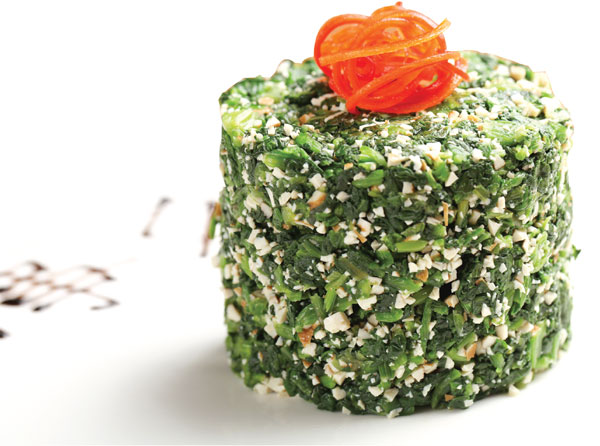
| Indian aster is best cooked in sizzling chicken fat, with pieces of dried tofu added to bulk up the dish. Photos Provided to China Daily |
All through the warmer seasons, she will frequently return from her morning walks with the dogs with bunches of greens that she will carefully soak in water.
She delights in discovering yecai, the wild vegetables that grow in nearby parks, by the canals or even on traffic islands. Her eaglelike gaze can spot them from miles away.
To untrained eyes like mine, they would have been just another lot of weeds, but our nanny has brought home an amazingly large selection of edible greens.
Shepherd's purse, lambs' quarters, wild amaranth, mugwort, fiddle heads, burr clover, Indian aster, dandelion, wild garlic, wild onions and chives are just a few that I can recognize and name.
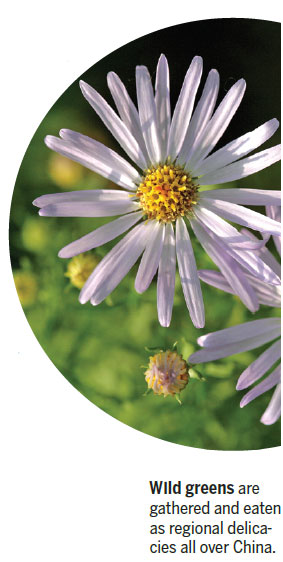
All over China, these wild greens are gathered and eaten as regional delicacies.
In Yunnan, they specialize in foraging edible buds and flowers, and spring and summer will see these lovingly gathered and sold at markets. Cassia flowers, wild cowpeas, jasmine, even purple shepherd's bane all make excellent omelets, soups and fritters. Demand is so high that they've started domesticating these plants.
And then there are the to on trees. Their deep red new shoots have a peculiar pungency that is much loved all over China. As soon as the shoots appear, they will be quickly plucked for omelets, chopped up with tofu, or deep-fried as leaf tempura.
After the flowers, Yunnan in summer will see foragers on its many hillsides and mountain slopes just after the rains, all looking for wild mushrooms such as hen of the woods, boletus, cepes and the beloved and most expensive of the mall, matsutake or pine mushroom.
Another popular summer vegetable here is the fiddle head, the tender young shoots of fern. The pretty curls are boiled and soaked in water before being sold in the market.
Down in the greater Shanghai hinterland, they love caotou or "grass heads", the burr clover, a plant that's related to alfalfa. These are tiny plants that appeal to the delicate local palate.
Another popular weed harvested around this time is malan tou, or Indian aster, a member of the chrysanthemum family. These leafy plants spring up along paddy dikes and ditches and are eagerly collected. They have started cultivating these, but any chef worth his salt will tell you the wild weeds are best.
Cultivated malan tou does not have the signature red stems that chefs look for in the naturally harvested sweet shoots.
They are best cooked in sizzling chicken fat, with pieces of dried tofu added to bulk up the dish.
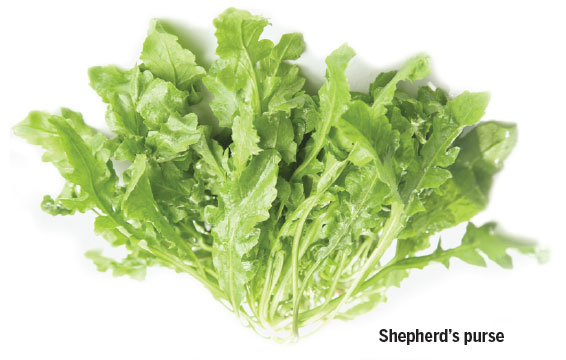
As we migrate up to the Central Plains, it's shepherd's purse country. All over Henan, the culinary memory is of jicai jiaozi, or shepherd's purse dumpling.
An ex-colleague tells me that for him, the taste of home every spring is his mother's dumplings filled with shepherd's purse. Early in the morning, his mother would go out to search the hills for this plant, which grows in a distinctive saw-toothed rosette. She would then bring her haul home and wash and blanch it before chopping it up for dumplings.
A platter of fat, juicy jiaozi filled with shepherd's purse and pork was the only thing that could assuage his homesick stomach.
Shepherd's purse is also stuffed in soup dumplings or wanton, cooked with noodles, made into various rice cakes or simply dunked in hotpots. It is probably China's most delicious weed.
All sorts of wild amaranth are collected and eaten. Apart from the paler varieties, the red-veined amaranth is a precious find. The Chinese believe it is good for anemia.
There is yet another amaranth they call huicai, or gray vegetable, that grows abundantly during the northern spring and summer. It is also known as lamb's quarter, perhaps for its fuzziness.
However, amaranth has to be carefully cooked and treated because of its high level of oxalic acid.
In the northern provinces, summer comes late and it is not until July that the meadows burst into bloom. Then, day lily buds can be harvested, eaten fresh or dried for food in winter.
There will also be wild chives flowering, and the flower heads are plucked, pounded and pickled in salt to make a very famous seasoning - jiucai hua. The flowering chives sauce is a fixture for any mutton hotpot meal.
Even later in the year, the wild garlic and sea buckthorn berries will ripen in the Mongolian deserts, and these will be carefully gathered and kept for winter. Sea buckthorn berries, especially, will provide crucial vitamins in the long winters to come.
Wild weeds. New leaves. Fresh flowers. For many Chinese, the memory of childhood is still locked with the coming of the seasons and the new growth that sprouts from the soil. All these are disappearing as more and more concrete covers the Earth, and that gives us more reason than ever to treasure and remember.
paulined@chinadaily.com.cn
Delectable dumplings are a treat
Shepherd's purse dumplings
(A recipe from my husband's grandmother)
500g jicai
200g minced pork belly
2 eggs, scrambled
Sesame oil, salt, pepper
1 teaspoon Sichuan peppercorns
50 dumpling wrappers
Add the Sichuan peppercorns to about two tablespoons of oil, fry till peppercorns are fragrant. Discard peppercorns and keep the oil.
Wash shepherd's purse thoroughly, especially if you picked them yourself, rinse in several changes of water. Blanch the min boiling water and rinse in cool water. Squeeze dry and chop finely.
Season minced pork belly with salt, pepper and sesame oil. Mix in chopped jicai and scrambled eggs. Mix well and pour cooled Sichuan peppercorn oil over mixture. Blend thoroughly.
Wrap the dumplings, nipping them firmly shut. You can either cook the dumplings in water or fry themas pot stickers.
Serve with chili oil and vinegar with minced garlic.
Shepherd's purse needs the extra oil for a better, smoother texture. When my husband's granny made these, pork was still a rare treat, so scrambled eggs helped the filling go a longer way.
(China Daily Africa Weekly 06/02/2017 page19)


Today's Top News
- China's manufacturing PMI at 50 in May
- WHO urges rethink on DR Congo Ebola travel bans
- Chinese SOEs report 1.9% profit growth in first four months
- China, EU discuss establishment of trade and investment consultation mechanism: ministry
- Renewable Energy Law country's green transition spur
- Xi exchanges congratulations with Egyptian president on 70th anniversary of ties





