



King of the road and man of letters









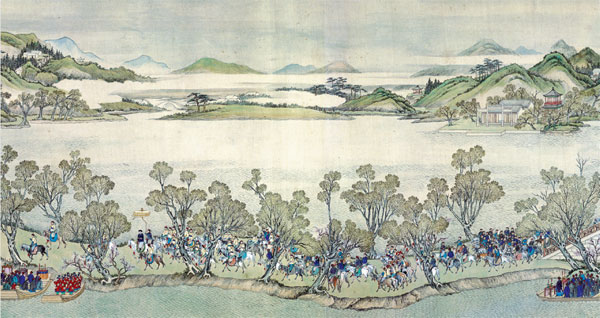 |
| Emperor Qianlong's penchant for travel. [Photo provided to China Daily] |
Emperor's penchant for travel was tightly bound to his reputation for being highly educated.
On all the evidence, Emperor Qianlong of the Qing Dynasty (1644-1911) loved to be on the road: he traveled 11 times to Shandong, the hometown of Confucius, whose musings became almost holy writ to generations of rulers.
However, it was his trips to Jiangnan, areas south of the Yangtze River, that are better known to modern-day Chinese, partly thanks to period TV dramas loosely based on these journeys.
In these renditions, which invariably romanticize Qianlong (1711-1799), the Qing Dynasty's longest-reigning emperor often comes across as a dashing man whose appeal lay as much in his courtly style as in his courtships. And Jiangnan, known for its strong literary tradition, was a natural place for the emperor to wield his folding fan and show off his prowess with words.
He would no doubt have objected to many aspects of this image, but there is at least one he would have agreed on: power aside, he was indeed a man of words and a rightful heir to the country's millennia-old literary tradition.
As such, it was almost obligatory for him to pay visits to Jiangnan, the spiritual home for any Chinese of his time who considered himself, and rarely herself, a member of the literati.
Ma Shengnan of the Palace Museum in Beijing says: "What's special about Qianlong is the fact that as an emperor of ethnic minority descent he used this tireless literary pursuit - throughout his life, the man himself penned an astronomical number of poems, 90,000 of them - as a way of gaining legitimacy for his rule.
"In history there were only two groups of ethnic minority people that had ever ruled over all of China. The Manchus, founders of the Qing Dynasty, who hailed from the frozen plains of the far northeast, was one of them. From the very beginning, generations of Qing rulers tried to embrace the classical majority culture, a policy Qianlong implemented with heart and soul."
Ma is the curator of an exhibition at the Zhejiang Museum, the largest on the emperor since 2015, when the Palace Museum mounted a show with works of painting and calligraphy within its holding. For the 2015 display all the selected works were from Shi Qu Bao Ji, an enormous compilation the emperor commissioned based on his royal collection.
- Emperor Qianlong's musket expected to fetch millions at London auction
- Emperor Qianlong's treasures exhibited in Chengdu
- Qianlong Edition of Tripitaka donated to Palace Museum
- Vase that was likely gifted by Qianlong Emperor breaks Irish record at auction
- Exhibition on Emperor Qianlong goes to West Lake















