



New guidelines help to preserve old features









Nanluoguxiang, a popular alleyway in Beijing's Dongcheng district, was one of the first hutong in Beijing to embrace commercialism. However, it quickly became overcommercialized, and the local administration was forced to find a way of balancing commercial development and the protection of the traditional neighborhood.
Initially, tourists, particularly those from overseas, were attracted by the small stores selling local crafts, and by restaurants offering unique cuisine in the hutong, one of the best-preserved traditional neighborhoods in the Chinese capital.
However, as visitor numbers rose dramatically after 2008, the potential for profit saw more store owners selling cheap, low-quality souvenirs, while established outlets that offered traditional delicacies were replaced by stalls selling deep-fried squid and other nonlocal snacks.
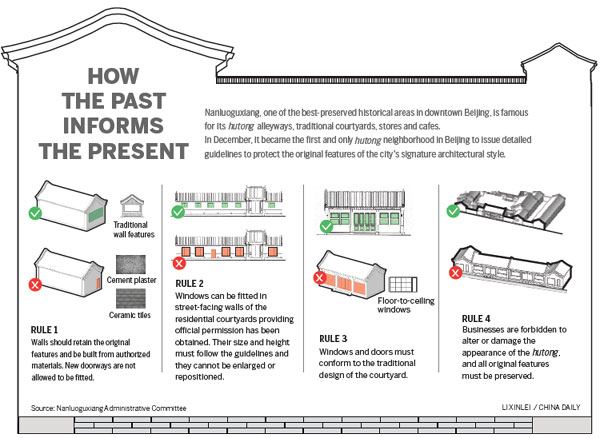
The new businesses also came under fire for destroying the area's traditional architectural style by enlarging windows and making new doorways.
"Business owners have eventually realized that random development is killing Nanluoguxiang and that it has to stop. It is our responsibility to retain the traditional features, so commercial development must be clearly regulated," said Xu Yan, head of the Nanluoguxiang Business Owners Association.
Xu discovered that the various business owners had different views about traditional features, so he decided to draft guidelines explaining what the traditional features should be.
In December, with the help of the local government, Nanluoguxiang became the first and only hutong neighborhood to issue detailed guidelines to preserve the original features of the city's signature architectural style.
All businesses owners and residents of 24 other hutong in the area have to follow the guidelines, which clarify the application procedures people have to follow if they intend to carry out renovation works.
The guidelines provide information about the types of doors that are permissible and the sort of tiles that should be used to repair or replace roofs.
To meet the requirements, all 154 businesses on Nanluoguxiang have carried out renovation work. So far, 33 wall openings have been blocked.
Ji Hong lives in Yu'er hutong, which is connected to Nanluoguxiang. She said the change has been obvious since the renovation.
"The nasty smell of deep-fried food no longer lingers over the neighborhood. The street is much cleaner too," the 60-year-old said.
Though some of Ji's neighbors in her crowded courtyard decided to move to apartment buildings after receiving relocation incentives from the government earlier this year, she chose to stay. "I love the atmosphere of the hutong, which is unique and precious. My roots are here," she said.
"The guidelines have revived the old alleyway, which has existed since the Yuan Dynasty (1271-1368). I hope business owners in other commercial hutong will adopt similar mechanisms as quickly as possible because this system works."


- 'Emotional education' to counter AI-driven job uncertainty
- Increase in western Pacific military activities noted
- China, Pakistan pledge deeper military ties
- SPP to oversee handling of Shanxi mine explosion case
- Mine blast victims get mental health counseling
- China leads with ‘deep and real’ methane control efforts, expert says





