



Titan's giant strides seek to recover lost ground









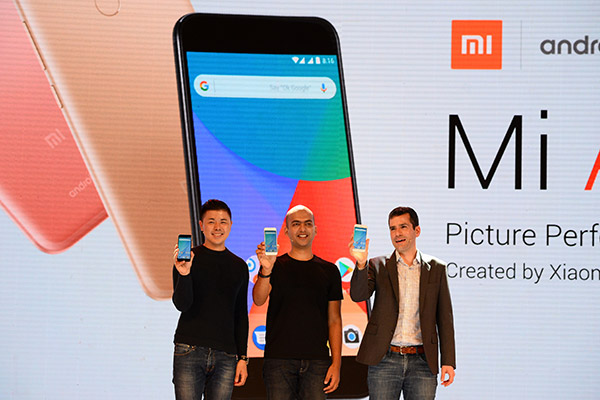 |
| (Left to right): Donovan Sung, director of product management and marketing of Xiaomi Global; Manu Jain, managing director of Xiaomi India; and Jon Gold, global director of Android Partner Programs, launch the Mi A1, Xiaomi's flagship, dual-camera smartphone at a function in New Delhi on Sept 5, 2017. [Photo/Agencies] |
Xiaomi steps up global expansion to ride the 'third wave' of chances
Xiaomi Corp is expanding its overseas footprint to complete its transformation from a Chinese smartphone maker into a technology giant.Sitting on a recent 1 billion loan, and armed with more international patents, Xiaomi, founded in 2000, is itching for global marketing scraps with Apple Inc and Samsung Electronics Co.
On Aug 24, the Beijing-based company announced its formal entry into Thailand in collaboration with distribution partner VST ECS (Thailand) Co Ltd. At the event, Xiaomi announced that its flagship smartphone, the Mi 6, as well as the Redmi Note 4, are now available in Thailand.
The move came shortly after Xiaomi said in July that its wholly-owned subsidiary Xiaomi HK Ltd had signed a three-year $1 billion syndicated loan agreement with 18 banks.
A big part of the money would be used to accelerate global expansion.
So far, Xiaomi has a presence in over 40 countries and regions, with impressive growth in Indonesia, Russia, Ukraine, India and other markets.
Lei Jun, founder and CEO of Xiaomi, said competing for global market share represents the third wave of opportunities that will shape the Chinese smartphone industry.
The first wave of opportunities came on the back of urban Chinese smartphone adoption; the second wave came thanks to new smartphone users in China's third- and fourth-tier cities.
"Seizing this opportunity marks the beginning of Xiaomi's journey as a technology company on the global stage," Lei said.
According to the company, after three years of investments to explore overseas markets, it has racked up successive wins this year.
"Our performance in India has been especially encouraging-revenue in the first half of this year is up 328 percent year-on-year and we are now the second-ranked brand in the overall Indian smartphone market," Lei said in a company memo in July.
The performance is in line with forecasts. Data from research consultancy Strategy Analytics showed that in the second quarter of this year, Xiaomi had acquired 15.6 percent share of India's smartphone market. In comparison, the corresponding number in 2016 was 3.3 percent.
Neil Shah, research director at Counterpoint Technology Market Research, said Xiaomi is dominating the online sales channel in India with sub-$150 phones, similar to the market segment it won in China when it was at its peak.
Such performance marks a turnaround, considering the tough time Xiaomi had a year ago. Back then, its shipments plummeted over successive quarters amid mounting competition in China from fellow Chinese players such as Huawei Technologies Co Ltd and Oppo Electronics Corp.
Its online-sales model was also widely questioned as consumers in small cities were still more willing to buy smartphones at brick-and-mortar stores.
In response, Xiaomi stepped up investments in research and development, and embraced the New Retail model, successfully integrating online and offline retail partners.
In the second quarter of this year, it shipped 23.16 million smartphones globally, up 70 percent sequentially, marking a record high for its quarterly smartphone shipments.
Wang Xiang, senior vice-president in charge of Xiaomi's global expansion, said there are plans to open 2,000 brick-and-mortar stores within three years, with half of them overseas.
Also, Xiaomi is channeling more resources into innovation. In February, the company launched the Surge S1, a proprietary chipset, helping it to join the ranks of Apple, Samsung and Huawei which have mastered the complicated in-house chip-making capabilities.
"Innovation combined with patent accumulation is the cornerstone of Xiaomi's overseas expansion strategy," Lei said.
The company has 4,806 patents, of which 2,404 are international patents. According to Lei, Xiaomi will hire thousands of R&D professionals for its smartphone business within the next 12 months, as part of its broader push to reach the goal of shipping 100 million smartphones in 2018.
The company did not disclose how many handsets it shipped last year.
To expand its technology portfolio, Xiaomi has signed a multi-year patent agreement with Nokia in July. The agreement includes a cross license for each other's cellular-standard patents. Xiaomi has also acquired patents from Nokia as part of the transaction.
The move came after it bought around 1,500 patents from Microsoft Corp last year.
"The intellectual property partnership with Nokia, once the world's biggest phone maker, can help it tackle potential legal disputes overseas," said Xiang Ligang, a telecom expert and CEO of telecom industry website cctime.com.











