



Long March rocket launch a success









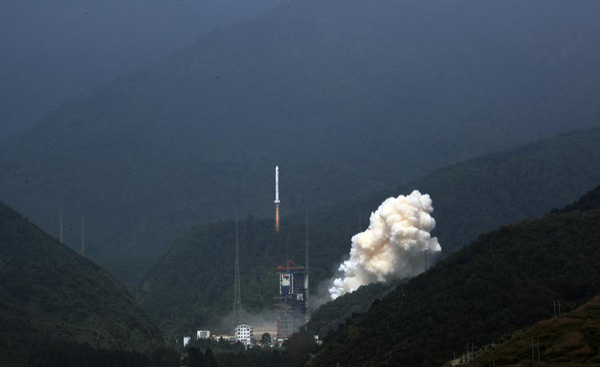 |
| The Long March 2C carrier rocket blasts off at the Xichang Satellite Launch Center in Sichuan province on Sept 29, 2017. [Photo/Xinhua] |
China used a Long March 2C carrier rocket on Friday to lift three satellites, indicating the nation has resumed its space launches after a major failure in July.
The rocket blasted off in the afternoon at the Xichang Satellite Launch Center in Sichuan province, successfully placing three Yaogan 30-1 satellites into orbit, according to a news release from China Aerospace Science and Technology Corp, the major contractor of the country's space programs.
Developed by the Chinese Academy of Sciences, the satellites will be used to carry out technological experiments on electromagnetic environments, the release said.
The success of Friday's launch has shown the company's efforts to rectify problems and improve its rockets' quality have achieved their goals and will bring confidence to its workers, the company noted.
This was the 251st flight of the Long March rocket family and the first in nearly three months since July 2, when the second mission of China's newest and strongest rocket, Long March 5, failed due to malfunctions.
The failure has affected the country's space programs, as it has had to postpone several key missions. One such mission was the Chang'e 5 lunar expedition, set to send a rover to take samples from the moon's surface and bring them back to the Earth.
China's mightiest and most technologically advanced launch vehicle, the Long March 5 has a liftoff weight of 869 metric tons, a maximum payload of 25 tons to low-Earth orbit and a max payload of 14 tons to a geosynchronous transfer orbit. The Long March 5's payload capacity is about 2.5 times bigger than any other Chinese rocket.
The rocket's first flight was carried out in November at the Wenchang center. Chinese scientists wish to use the rocket to send large probes to the moon, Mars as well as Jupiter. They also plan to use it to transport parts for a manned space station that will start construction around 2019.


- China's State Council sets up team to investigate Shanxi coal mine explosion
- Desert fighter, US friend to reunite soon
- Serbian president meets HBIS chief, backs green steel push in Belgrade
- Chinese-built cruise ship passes sea trials
- Senior Jiangxi official Li Wei investigated for discipline violations
- Guangzhou launches latest affordable housing scheme





