



Cuban scientists deny sonic attacks on US diplomats









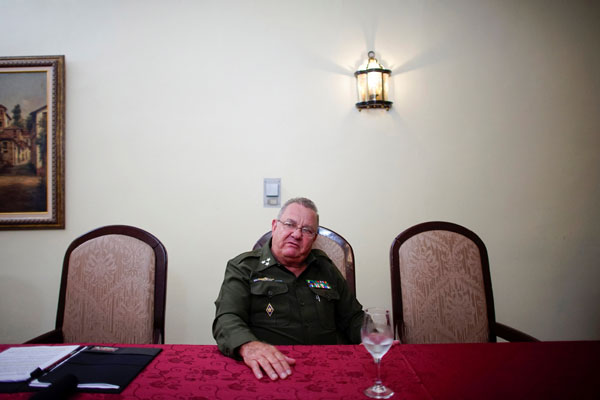 |
| Cuban Interior Ministry's Colonel Ramiro Ramirez, who leads a team investigating US complaints of "attacks" on diplomats in Havana, speaks during an interview at the Hotel Nacional in Havana, Cuba, Oct 22, 2017. [Photo/Agencies] |
HAVANA - Two Cuban scientists have denied the accusations that Cuba targeted American diplomats and their families in Havana with sonic attacks, saying this was a pretext to harm relations.
"What is being published by the media is full of falsehoods and ignorance from a physical perspective," Daniel Stolik Novygrod, professor at Havana University, was quoted as saying by the Juventud Rebelde daily on Thursday.
He was backed up by Carlos Barcelo Perez, professor at the Institute of Hygiene, Epidemiology and Microbiology, who said such an attack is "categorically impossible."
Both experts concurred that the events could not have taken place in rooms of the Hotel Capri, where some of the attacks were reported, or in diplomatic residences, without being heard by the neighbors.
Stolik Novygrod explained that the frequency of such sonic attacks could not have been infrasonic, as these are lower than the human ear can detect and the victims claimed to have heard the sounds. Equally, they could not have been ultrasounds as these are used in medicine, without harming the hearing of those using them.
According to the US government, 24 diplomats and relatives suffered from sonic attacks, beginning in Nov 2016 and causing problems of hearing, balance, sight and even memory loss.
The two scientists said that infrasound and ultrasound frequencies alike cannot be easily directed. They tend to spread in all directions, making it impossible to target them at a single individual in a room.
"There can be many hypotheses but the physical characteristics allow us to say it was not a sonic attack," said Stolik Novygrod.
He suggested that one option could be the sonic weapon, known as the Long Range Acoustic Device (LRAD), an acoustic device that can emit sounds over great distances, which has been used in the US to disperse protests, but an LRAD would have affected several entire buildings, and also could not be targeted so specifically.
In early Oct, the US expelled 15 Cuban diplomats, after reducing its own diplomatic presence in Havana following the alleged sonic aggression.










