Rail line lays tracks for change in Laos









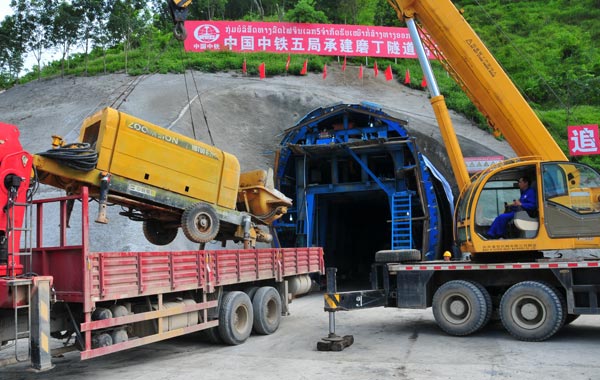 |
| Workers speed up construction of the railway tunnel connecting Southwest China's Yunnan province and Laos in May. The tunnel is expected to benefit both countries.[Photo by Yuan Wenlang/Xinhua] |
In Mohan, a small town in Yunnan province bordering Laos, construction of the Friendship Tunnel is making brisk headway seven days a week.
The 9.68-kilometer railway tunnel will connect both sides of the border, with 7.17 km in China and 2.51 km in Laos.
Boring the tunnel began in June 2016. Running slightly behind schedule due to challenging geological conditions, the project is scheduled for completion in July 2019.
"The railway tunnel starts here in China's Mohan, and the other end will be in Boten, Laos," said Zhang Shuai, secretary and engineer for the tunnel project contractor China Railway No 2 Engineering Group, as he pointed to an underground passage below the rolling mountains.
"The Friendship Tunnel is China's first railway tunnel that crosses the border," he said.
When completed, it will be a crucial link for passenger and freight trains, connecting the rail networks of both countries.
Chen Lijun, a researcher and director of the Institute for South Asian Studies at the Yunnan Academy of Social Sciences, said the new railway will boost the economy of the rural town of Mohan.
"Just as the Chinese saying goes, better roads lead to better life, Mohan residents will see more new houses and cars as the town becomes a major node on the China-Laos railway," he said.
There is a similar sense of anticipation for Boten and other areas in Laos near the border.
Boten is the starting point of the 414-km Lao section of the China-Laos railway to Vientiane, the Laotian capital. It is the first overseas rail route linking China's network, using Chinese technology and investment.
With a total investment of 40 billion yuan ($6.1 billion), the Chinese and Laotian governments established a joint venture last year to build, manage and operate the railway.
China will finance and own 70 percent of the venture, while Laos will be responsible for the remainder.
The challenging project will see China export its top railway technology, with more than 62 percent of the route requiring bridges and tunnels.
Six Chinese companies have successfully bid for the construction of the Boten-Vientiane railway, ensuring the application of Chinese standards, equipment and technology.
"The success of the China-Laos railway will have international significance, manifesting China's true ability in taking its railway technology abroad," said Luo Hengfu, China Railway No 2 Engineering Group's project manager for the Friendship Tunnel at Mohan.
The railway construction project will involve 20 Lao firms as subcontractors, supervised and assisted by Chinese companies.
The Lao section of the railway will run south toward Vientiane through the provinces of Luang Namtha, Oudomxay and Luang Prabang.
Work on the Lao section began in March in Luang Namtha, with the route's overall completion date set for 2021.
When up and running, the Vientiane terminus will link to the railway network of Thailand that stretches to Bangkok and further connect to Kuala Lumpur, Malaysia, and eventually to Singapore.
Passenger trains will run at 160 kilometers per hour in mountainous areas and up to 200 km/h on the plains, while freight trains will run at 120 km/h.
At the moment, the only railroad in Laos is a 3.5-km extension of Thailand's state railway network.
Roads still dominate the transport sector in Laos, representing 98 percent of the total travel of passengers and 86 percent of freight moved, according to the Lao Ministry of Public Works and Transport.
According to a recent study by the Japan External Trade Organization, logistics costs in Laos are up to twice those of other countries in the Association of Southeast Asian Nations.
The journey from Vientiane to the Boten border point will be reduced from around three days by road to less than three hours by rail. Freight rates will drop to 269,750 kip ($32) per metric ton, only one-third of the price by road transport, according to a study by Lao authorities.
Contact the writer at iris@chinadailyhk.com