



On his majesty's service, and at his mercy









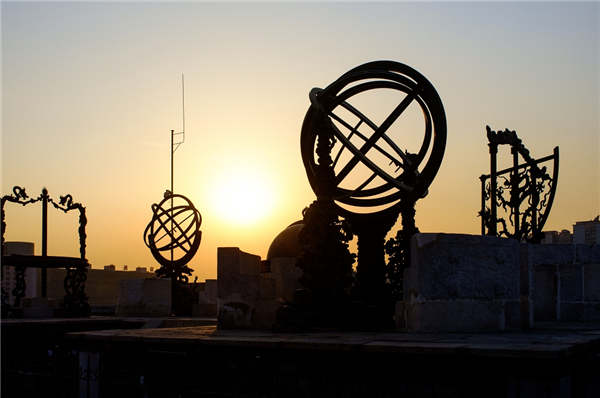 |
Astrological instruments constructed under the supervision of Jesuit missionaries during the Qing Dynasty and housed at the Beijing Ancient Observatory. [Photo provided to China Daily] |
"For the missionaries, who would not have enjoyed such high-profile presence without the Chinese emperors' patronage, the royal favor was in fact a double-edged sword," Li says.
Later, in 1692, Emperor Kangxi, facing contentions rising from within the Catholic missionaries in China, issued the Edict of Tolerance Toward the Catholic Faith. It decreed that all missionaries wishing to stay and do missionary work in China must show respect to local culture and customs. The events leading to the issuance of the edict marked a turning-point in the relationship between the missionaries and the Qing rulers.
When Emperor Yongzheng, the son of Kangxi and a devout Buddhist, succeeded his father in 1722, he further tightened the control over Western missionaries, banning their religious activities in almost every corner of his empire.
However, one place was exempt-the Forbidden City in Beijing, the royal palace and center of power for hundreds of years. There the missionaries continued to serve the emperor with their expertise in nonreligious matters.
"Sometimes they seemed more like decorations to the court than daring and passionate men who had traveled the globe guided by an urge to convert," Li says.
One of them was the Italian Giuseppe Castiglione (1688-1766), a missionary turned court painter whose half-century stay in China coincided with the reign of three Qing emperors. In one of his portrait busts, Emperor Yongzheng appears wearing voluminous brown curls-wig style popular with the Western monarchs and aristocracy of his time.
Castiglione later became the de facto official portraitist for Emperor Qianlong, son and successor of Yongzheng. Qianlong also recruited the Polish missionary Florian Joseph Bahr and his Czech counterpart Johann Walter among others, in forming his own chamber orchestra.















