



Ivory carvers worry skills may be lost









Ban on commercial processing pushes artisans to other materials
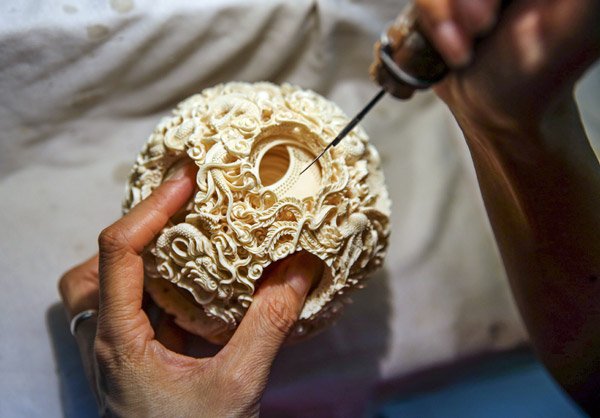
Ivory carvers in Guangzhou, Guangdong province, one of the major production and sales centers of ivory products in China, said they have turned to work on substitute materials and that the ban on the commercial processing and sales of ivory has had a limited effect on them so far.
The State Forestry Administration announced that China had ended the commercial processing and sales of ivory at the end of 2017 as planned, calling it China's "New Year's gift to the elephant". While it is good news for the African wild elephant population, which is declining due to poaching, it means that it will be difficult to pass on ivory carving skills.
According to the administration, the ban affects 34 processing enterprises and 143 designated trading venues, with all of them suspending businesses.
In Guangzhou, some ivory carvers and stores have turned to the tusks of mammoths, a longhair elephant that became extinct during the ice age.
Ma Zhuobin, a Guangzhou ivory engraver who owns a store, said his store began to sell carvings of mammoth tusks instead of ivory carvings last year, and achieved a sales volume of 300,000 yuan ($46,150), which he felt was satisfactory.
As no store can sell ivory carvings, "the ban helps spur the sales of mammoth tusk carvings and other ornamental carvings, and the prices of these carvings have all gone up," he said.
At his store, the prices of mammoth tusk carvings have climbed to the level of ivory. For example, a hollowed-out mammoth tusk ball of 35 layers is priced at 380,000 yuan, "very close" to the price of an ivory ball of the same design.
The mammoth tusks he used are imported mainly from Russia and other central Asian countries and regions. Because of the ban, the price for the nonrenewable raw material of mammoth tusks has increased as well, he said.
Another carving store owner, who gave only her surname, Huang, reported a similar situation. The sales of ornamental carvings of mammoth tusk, bone, wood and stones in her store has even enjoyed a slight rise since the ban took effect, she said.
But how to pass on their skills remains a concern for ivory carvers.
Listed as a State-level intangible cultural heritage since 2006, China's traditional ivory carving peaked in the Qing Dynasty (1644-1911). Beijing and Guangzhou were the ivory-carving centers.
People in the trade agreed that the ban on ivory processing and sales would affect ivory carvers from passing on their skills and technologies in the years to come, as substitute material cannot be identical with ivory.
Ma, the store owner, said the reserve of mammoth tusks, which is the most similar substitute material for ivory, is likely to run out in about 50 years, while other materials, such as ox bone and wood, are different in terms of carving skills.
Therefore, in the long run, the technique is likely to be lost, he said.
Zhang Minhui, an ivory carving master, believed that ivory engravers should keep pace with the times.
Starting to explore the use of ox bones for carving 20 years ago, he found that ox bones are cheap and abundant, but are small, rough and fragile. He invented a technique to clean the mildew from ox bones while retaining their gloss, and to put together hundreds of small bones to imitate elephant ivory.
"It will require our wisdom to find a way to pass on our skills to younger generations," he said.
Cai Yanhuan and Xinhua contributed to this story.


- China's State Council sets up team to investigate Shanxi coal mine explosion
- Desert fighter, US friend to reunite soon
- Serbian president meets HBIS chief, backs green steel push in Belgrade
- Chinese-built cruise ship passes sea trials
- Senior Jiangxi official Li Wei investigated for discipline violations
- Guangzhou launches latest affordable housing scheme





