



Forging stronger ties among Lancang-Mekong nations









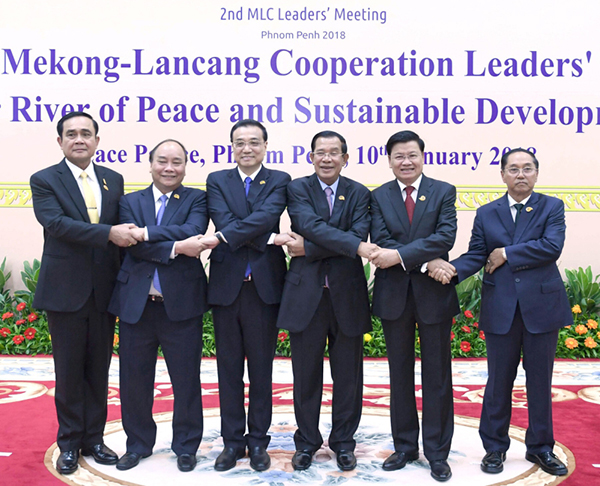
The latest Lancang-Mekong leaders' meeting has proved to be a summit not paying lip service, but yielding tangible results, bringing the countries closer to a community of shared future.
Leaders of China, Myanmar, Laos, Thailand, Cambodia and Vietnam talked about project-based, mutual respect for common development, before signing the Phnom Penh Declaration and adopting a five-year action plan (2018-2022) at their meeting on sustainable development.
All 45 early harvest projects identified at the first leaders' meeting in 2016 are on schedule and the Lancang-Mekong Cooperation (LMC) fund set up by China will continue to support 132 projects. In addition, China will provide more than 6 billion U.S. dollars of loans and credit for production capacity and equipment manufacturing cooperation.
Signature projects such as the Kunming-Bangkok road, China-Laos railway and the Long Jiang Industrial Park in Vietnam are underway.
The six countries cooperate by consensus, turning their economic advantages into development cooperation. With progress and results delivered daily, monthly and annually, a truly remarkable LMC speed has been created, and a defining LMC culture featuring equality, sincerity, mutual assistance and kinship has been established.
Amid lackluster global economic landscape, the LMC mechanism has demonstrated strong vitality and robust development momentum under the guidance of the leaders of the six countries.
China is the largest trading partner of Cambodia, Myanmar, Vietnam and Thailand and the second largest of Laos. Trade between China and the five totaled 220 billion U.S. dollars in 2017, up 16 percent year on year.
Some 80 percent of China's rice imports are from Mekong countries, and fruit exports to China have increased by an average of 21 percent each year in the past decade.
China was the largest source of foreign investment for Cambodia, Laos and Myanmar, the third for Thailand and fourth for Vietnam in 2017, according to China's Ministry of Commerce.
The deficit that China holds with the Mekong countries on farm product trade will not prevent China from importing more. Protectionism is China's last choice.
With the global economy recovering, LMC countries have a chance to consolidate their political will and deepen cooperation in the win-win spirit.





