


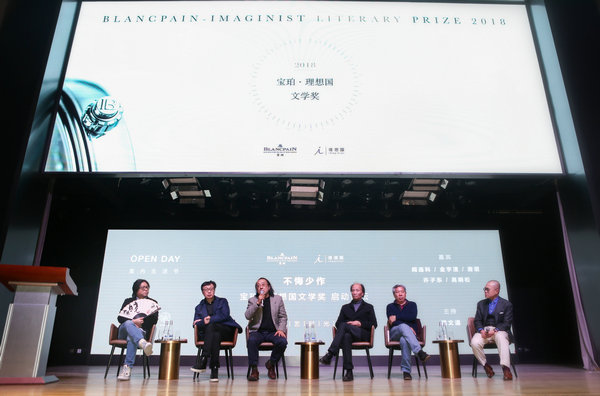
A new literary prize of 300,000 yuan ($47,700) has been set up to encourage talented Chinese writers under the age of 45 to become established and successful writers.
Young authors with novels or short stories published in simplified Chinese on the Chinese mainland between January 2017 and next month are eligible to participate.
Entries should be submitted before May 31 and the winning entry will be announced in September.
"We want to hold a festival for those people who are writing and publishing in obscurity. They need to be seen, not only because they have written great works, but also to show them that their careers will improve," says Liang Wendao, a renowned writer and TV commentator.
He was in Beijing on March 24 to host the opening ceremony of the Blancpain-Imaginist Literary Prize 2018, which was co-founded by the Swiss watchmaker Blancpain and Imaginist, a publishing brand in China.
During the ceremony, five judges, including well-known and experienced writers, critics, editors and scholars, recalled their early days of writing.
In response to the central question of whether writers regret their early work, the panel offered suggestions on how the younger generation should develop their approach to writing novels.
Yan Lianke, 60, a Chinese writer who has won several major Chinese and international literature prizes and who has been shortlisted for the Man Booker Prize on three occasions, looked back upon his first short story, titled The Story of Gastrodia Elata, which was published in 1979. According to Yan, his descriptions of landscapes impressed the editor more than the story itself.
His own harshest critic, Yan described 80 percent of his works as "rubbish" and thought that only 20 percent of writing showed enough vitality to last his lifetime. He also "blamed" himself for not starting to read foreign literature until the age of 20.
"I have been writing in regret my entire life. The only thing I don't regret is the fact that I'm fairly diligent. Even so, the sense of regret I've felt about my novels is still overpowering," Yan says.
Xu Zidong, 64, a cultural critic and professor of Chinese literature at Hong Kong Lingnan University, first became aware that it was possible to write a novel after reading one of Mao Dun's early works, Disillusion. But at the age of 15, he was too young to understand the value of the work by one of China's most acclaimed modern novelists and cultural commentators. However, Xu's dream of becoming a writer soon brought him disillusionment when he refused to modify his drafts and conform to the mainstream discourses of the time.
"One may tell lies in many circumstances, yet he cannot tell lies in his own creations when he knows them to be fake," says Xu, adding that although his books are few in number, he believes they will stand the test of time.
Jin Yucheng, 66, a Shanghai-based writer and the executive editor of the magazine Shanghai Literature, talked about his formative years in Heihe in Northeast China's Heilongjiang province during the "cultural revolution" (1966-76).
Although he had discussed the possibility of writing novels with a friend through letters, he didn't start writing until he was in his thirties.
"The eight years in Heihe turned me into a northeasterner in terms of writing," says Jin, who wrote several stories in his early years that featured funeral customs, the daily routine of work and the struggle to find food at that time.
"However, it was only recently that I realized I didn't touch upon the real nature of the Chinese countryside," Jin continued, adding that the illusion of setting down roots in the Northeast finally reminded him of what he had forgotten-h(huán)is childhood in Shanghai, the early life that he was most familiar with.





