



It's time Australia changed its China policy









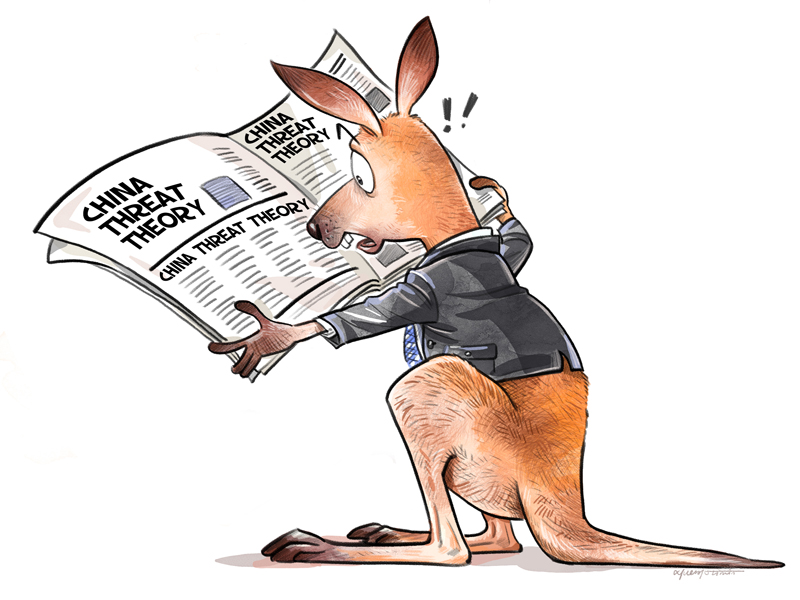
The Australian media have been trying to hype the "China threat" theory-the latest example being a piece of fake news which says, "China will establish a permanent military base in Vanuatu" and claims the move will change geopolitics in the South Pacific. Another example is the reports, based on hearsay, which first surfaced about a year and a half ago, claiming China was buying political influence in Australia-which Beijing firmly refuted last year.
Although Australia claims to have "cured" itself of the Cold-War mentality, it still accords excessive priority to security over economic cooperation. For proof, one has to just look at Australia's Foreign Policy White Paper released in November 2017, which highly values the country's longtime partnership with the United States and views with suspicion the actions of China, its largest trade partner.
Australia, it appears, believes in the strategy of using both China and the US to maximize its security and economic interests, but the fact is that the strategy has hampered its long-term development.
Thanks to its security-centered strategy, Canberra backs the Washington-led international order. While it seeks a rule-based order in the Asia-Pacific region, it also seeks a military and political alliance in the "Indo-Pacific" to check China's increasing regional influence, but not its trade.
Signals from Australia have been mixed. While on the one hand the White Paper stresses the need to consolidate the US-Australia alliance and claims China is a "threat to the world order", on the other hand Australian President Malcolm Turnbull said China was not a threat before embarking on a visit to the US in February.
Besides, Australia's stance on the China-proposed Belt and Road Initiative is muddled and confused. In fact, abc.net.au has quoted Nick Bisley, a China expert from La Trobe University, as saying: "The challenge is to say how do we show a little bit of skepticism and caution without necessarily saying, 'Everything you do, China, must be seen as a threat to our national security'."
Over the past 10 years, Australia has benefited from its pragmatic and practical diplomacy. But it seems Washington's political pressure-perhaps using security as a bargaining chip-prompted Canberra to adjust its diplomacy, which has had a negative impact on China-Australia ties.
Plus, what many call a looming trade war between China and the US has put Australia in a rather tough situation, where its strategy of using both China and the US will neither earn it more profits nor strengthen its security.
So it is necessary for Canberra to adjust its cooperation strategy, and accord the deserved importance to its relations with China, which is not only the largest investor in Australia but also Australia's largest market. Add to that the fact that China is the source of the largest number of foreign tourists and students to Australia, and we have a perfect recipe for win-win trade cooperation and cultural communication between the two countries.
That Beijing-Canberra relations have the support of the peoples of both countries is also evident in a poll conducted by Australia's Lowy Institute, which says over the past five years, most Australians have come to recognize China as a friend, and an important trade partner despite the rise of anti-China sentiment in some parts of world after 2008. Moreover, Pew Research Center data in July 2017 showed people aged between 18 and 29 years in developed countries, who have been witness to China's remarkable development and achievements, hold a more positive attitude toward the country.
Given their mutually beneficial trade cooperation and positive public opinion, Australia and China should make more efforts to strengthen their relationship-for example, by forming a new international cooperation platform based on the Belt and Road Initiative-to further promote mutual prosperity and better safeguard regional stability.
Zhai Shilei is a researcher and Xie Gang an associate researcher at the Center for Australia Studies, China University of Mining and Technology.





