



Artifacts come alive with technology









FUZHOU - Xu Shaoqing stood in front of a large screen as a picture of a golden earring the size of a basketball appeared.
"The jewelry dates to the Warring States Period (475-221 BC)," the caption read.
Xu took out his phone, scanned a QR code beside the illustration, and a link with information about the earring opened on his phone.
The presentation is part of a new experience offered by the latest exhibition at the provincial museum in Fujian province.
A 4-by-2-meter high-definition touch screen displays facts about more than 300 artifacts from an exhibition about the Maritime Silk Road.
"If visitors miss the real exhibition, they can still enjoy it on the screen," said Gong Zhangnian, deputy director of the museum. "You can even browse the exhibition at home or on your phone."
Technology is making its way to more Chinese museums these days. Last week, the country's cultural protection agency issued guidelines for local branches, pledging to invest more in the digitization of artifacts.
China had 4,872 museums as of late 2016. They receive around 900 million visitors annually.
Shaanxi province, which has China's second-largest cultural collection, announced last month that it had created digital archives for more than half of its 282 public museums.
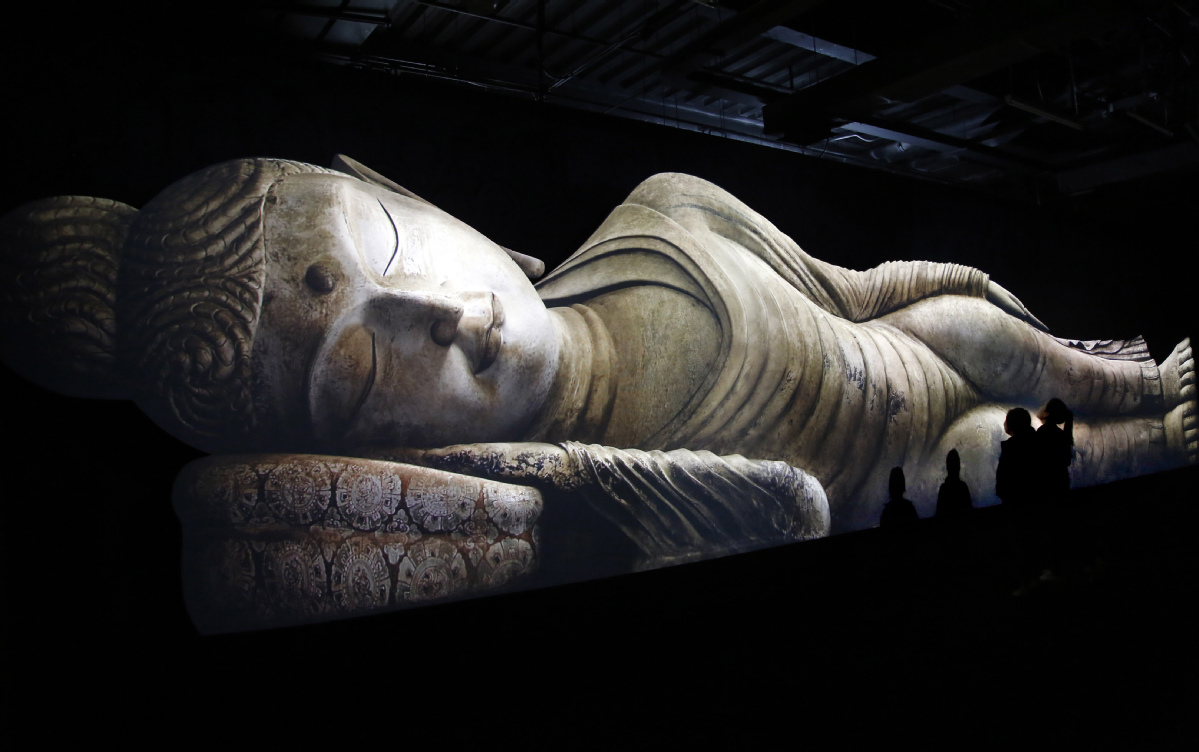
"We are planning to use 1,100 square meters of space for a smart exhibition," said Gong, explaining that augmented reality and virtual reality equipment will be used to provide a better interactive experience for viewing artwork.
Cultural institutions like the Fujian museum are teaming up with tech companies to promote cultural protection.
The China Foundation for Cultural Heritage Conservation announced last week that it will cooperate with Intel to protect the Great Wall of China.
Intel will use its artificial intelligence technology and drones to create HD images and 3D models of the cultural site, as well as gather necessary information for its renovation, according to the foundation.
Chinese search engine Baidu has been digitally archiving China's museums since 2012, enlisting more than 200 museums for the ongoing project. The institutions are also working with tech companies to create content in modern ways that will appeal to a younger generation.
The Palace Museum, or Forbidden City, in Beijing and Dunhuang Academy, famous for its UNESCO-listed grottoes, both teamed up with Chinese tech giant Tencent to create culture-themed content.
Products in the pipeline include memes and GIF images featuring historical Chinese figures and anime about the history and culture of Dunhuang's grottoes.
"The stories behind the cultural collections are rich, but often left untold," Gong said. "Tech helps these stories come alive."
Xinhua


- Idea of space solar power station closer to reality
- Xiconomics: How cooperation with China is transforming industries in Serbia
- Mainland slams DPP's sustained separatist agenda
- Robots expanding limits of mega projects
- Intl partnership targets poverty
- China's State Council sets up team to investigate Shanxi coal mine explosion





