



Beijing releases list of top air polluting sources









Vehicles still lead culprit, but dust from roads, construction rising
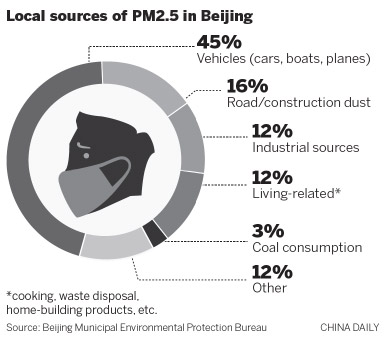
Experts warn that air pollution is rising from vehicles and kicked-up dust in Beijing, as the city published its list of major air polluting sources on Monday.
Currently, mobile sources, including automobiles, boats and planes, are the largest contributor for locally generated PM2.5 particulate matter that poses health dangers.
Last year, 45 percent of PM2.5 in the capital came from motorized vehicles. Diesel powered trucks stood out as the worst polluters of the bunch, the Beijing Municipal Environmental Protection Bureau said.
Its conclusions were drawn based on data from the Beijing Municipal Environmental Monitoring Center, together with Peking and Tsinghua universities and the Institute of Atmospheric Physics of the Chinese Academy of Sciences. The source analysis will help environmental authorities know how to prioritize their air pollution control work, the bureau said.
It's the second time that an air pollution source analysis has been done in Beijing. The last one was completed in 2013, but vehicles were the only items measured in the mobile sources category because of inadequate monitoring and analysis capabilities at the time. China had only started PM2.5 monitoring, said Liu Baoxian, deputy head of the municipal monitoring center.
The 2013 analysis found that internal combustion engines contributed to about 31 percent of the PM2.5 in the capital. "Pollutants from vehicles have decreased at a slower rate than PM2.5 concentrations overall in Beijing in recent years, meaning engine emissions are becoming a greater contributor by proportion," Liu said.
The research has also found dust-kicked up from roads and construction sites, for example-to be on the rise. The proportion of its PM2.5 contribution increased from 14.3 percent in 2013 to 16 percent last year. The research found, however, that the contribution from coal consumption decreased from about 22 percent to only 3 percent thanks to the shift in the region from bulk coal to clean energy sources for winter heating.
Locally generated pollutants were a major contributor to air pollution in Beijing last year. The average density of PM2.5 in the city was 58 micrograms per cubic meter in 2017, and on average about 34 percent of that was transported from other regions, Liu said.
The worse the air pollution in Beijing is, the bigger the contribution from outside pollutants, the latest research found. When the capital has been hit with heavy pollution, the proportion from outside pollutants went up by about 55 to 75 percent.
Wang Shuxiao, director of Tsinghua University's Institute of Air Pollution and Control, said China has long been thinking about conducting regular analysis of air pollution sources, but the idea is hindered by inadequate capabilities of local environmental authorities.
She said regular analysis will probably be kicked off soon in the 28 major cities in the Beijing-Tianjin-Hebei province cluster.


- Serbian president meets HBIS chief, backs green steel push in Belgrade
- Chinese-built cruise ship passes sea trials
- Senior Jiangxi official Li Wei investigated for discipline violations
- Guangzhou launches latest affordable housing scheme
- Shandong capital unveils Novi Sad-inspired sister city garden
- China's port throughput expands in early 2026 on strong container growth





