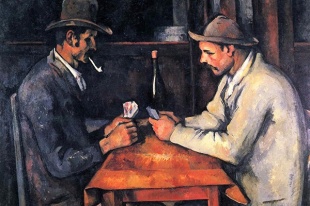



Field of dreams










Vollard was a legend in his lifetime and beyond. In 1887, at the age of 29, he arrived in Paris from Réunion, a remote French island colony east of Madagascar, and made his mark as a dealer when he staged Cézanne's first solo show in 1895. The painter had been living in obscurity in Aix-en-Provence in the south of France and his work hadn't been exhibited in more than 20 years. Vollard found Cézanne and bought more than 100 of his canvases. (The artist was 56 years old at the time.) The exhibition was a huge success – and Cézanne's place in the pantheon of modern art was set.
Matisse cobbled together every last franc he could find to buy a Cézanne and even young Pablo Picasso was mesmerised by the painter. Without Vollard's exposure of Cézanne, the school of what we now know as cubism might never have existed. Picasso remarked that his style was heavily influenced by Cézanne (who he called "the father of us all") and it was at Vollard's gallery that he first laid eyes on the artist's work. Like his fellow post-impressionists Gauguin and Van Gogh, Cézanne was thought to have improved immensely as he got older. His early pieces fall somewhere between Delacroix and Guercino, but his later work marks a dramatic shift.
In his lifetime, Cézanne paid the price for being a pioneer in the art world. He withdrew from Paris to his hometown of Aix-en-Provence; there, in isolation, he studied the perceived problems of art. Like Degas, he didn't have financial concerns and could therefore indulge, applying exacting standards to what he produced. And while he enjoyed the work of the impressionists in conveying nature, he felt that paintings of nature should not be aimed at copying an object, but realising one's sensations.
Not all artists liked impressionism. Some felt painting that was simply pleasing to the eye lacked in substance. But Cézanne felt that order and balance had been lost as artists sought the fleeting in-the-moment experience, ignoring the enduring forms of nature. He desired a simplification of natural forms into geometric essentials.
Van Gogh agreed; he thought by exploring nothing but optical qualities of light that art was in danger of losing its intensity and passion. And Gauguin famously went to Polynesia to address the issue. What we call modern art grew out of feelings of dissatisfaction; Cézanne's approach led to cubism and Picasso, Van Gogh to expressionism that went on to influence the Germans, and Gauguin to primitivism.