


Uncertain future looms for middle-aged people with Down syndrome










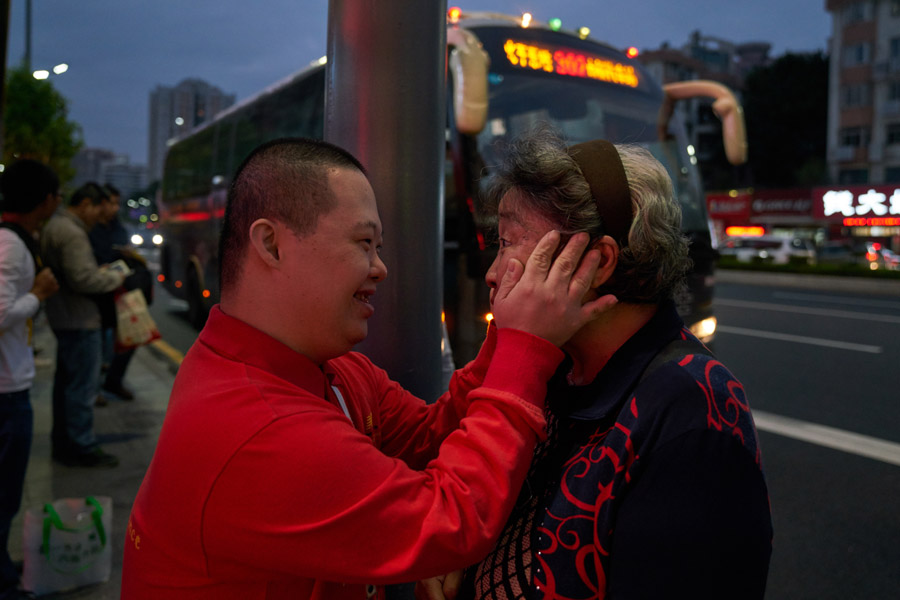
A lack of care options means many will have no support when their elderly parents die, as Xin Wen reports.
Meng Fanrong once considered jumping into the Pearl River in Guangzhou, Guangdong province, with her baby son in her arms because she was fearful of the future that awaited him.
Meng, now 70, quickly abandoned the idea, but her concerns over the future of her son, who has Down syndrome, persist nearly 40 years later.
Guo Feng, 39, is unable to speak, so he can't alert anyone if he is unwell or experiencing pain, and Meng can only discern his state of health through tiny changes in his expression. He is also unable to care for himself or perform basic tasks, and it took years to teach him basic skills, such as getting a newspaper from the newsstand or pouring water from the kettle.
Down syndrome, also called trisomy 21, is a genetic disorder that results when a person is born with three, rather than two, copies of chromosome 21.
The extra chromosome results in impaired mental capacity, delayed growth, flat facial features and lower immunity to a number of illnesses. The mental ability of an adult with Down syndrome is equal to that of a child age 8 or 9.
More than 2 million people in China have Down syndrome, according to the China Association of Persons with Intellectual Disability and their Relatives.
They have trouble communicating and controlling their emotions, and often rely on their parents for care into adulthood. As their parents age, though, the question of future care becomes an overriding concern.
People with Down syndrome generally take a long time to adapt to new environments, and some never adjust to new surroundings. Helping them to adapt requires knowledge of the syndrome, familiarity with the person's habits and endless patience.
As a result, many parents worry that without professional care, their children won't be able to adapt at all, and are concerned that caregivers will lose patience and mistreat their charges.





