


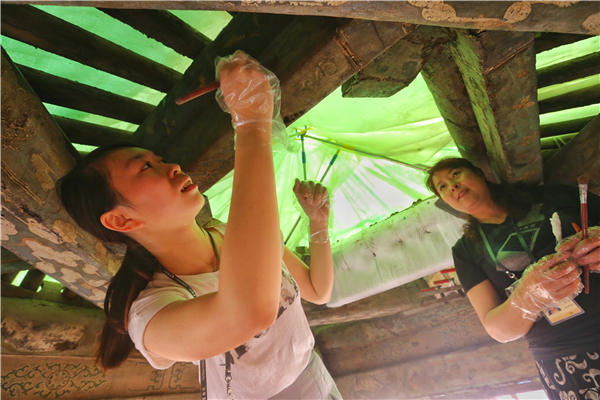
Educating more people
Nevertheless, the process of learning about cultural conservation still has to be man-aged in a structured way - not everyone can be permitted access to cultural relics every day.
As the world's most visited museum annually, the Palace Museum received about 16.7 million visitors in 2017. So, managing the human impact on the complex is another key factor to consider.
In 2016, Masters in the Forbidden City, a three-part documentary about the conservators working on cultural relics in the museum, went viral online, making the behind-the-scenes heroes celebrities overnight - and none more so than Wang Jin, an antique clock restorer.
This series was widely hailed as a huge success by the museum in its efforts to educate the wider public about its work. And this is just another facet that some of the interns need to learn more about.
Lou Si-man, 21, is an undergraduate majoring in education at the University of Macau. She is currently an intern at the Palace Museum's department of publicity and education.
"The biggest achievement since coming here is that I met Mr Wang Jin in the canteen," Lou jokes. "Everyone in our group lined up to take pictures with him."
Now, under the guidance of her tutors, she is exploring her own ways to promote the culture and work of the Palace Museum to a wider audience.
One of her current projects is to develop a course for sixth-grade elementary school students that explains the meaning behind the auspicious statues found on the roof ridges of the palace buildings.
"We're still discussing ways to make these cultural elements easier for children to understand," Lou says.
"Some people may go to work in a mansion every day, but we have these ancient buildings in which to 'work'. This environment provides us with a lot of inspiration."
And sometimes, inspiration pops up in the most unexpected places.
For example, the extraordinarily heavy rainy season in Beijing this summer provided undergraduate Ho Ka-hou, a history major from the University of Macau, with a new idea for a project.
The Palace Museum has a complex sewage system. When heavy storms hit, hundreds of statues in the shape of chi (a kind of Chinese dragon) heads channel water from the terraces. Since the southern section of the Palace Museum sits on lower terrain, the falling rain flows southward and drains into the surrounding moats.
"Within six weeks, I will draft a plan on how to explain this interesting but less-discussed part of the Forbidden City to young students," Ho says.
"History has many facets. It's better to use smaller concepts to help paint the bigger picture. This kind of course, with its narrowed-down topic, will be interesting."
He also wants to bring this style of learning to Macao.
"Macao has many attractive historical stories that haven't been clearly explained to local people," he says.





