



Winds of change blow for finless porpoise









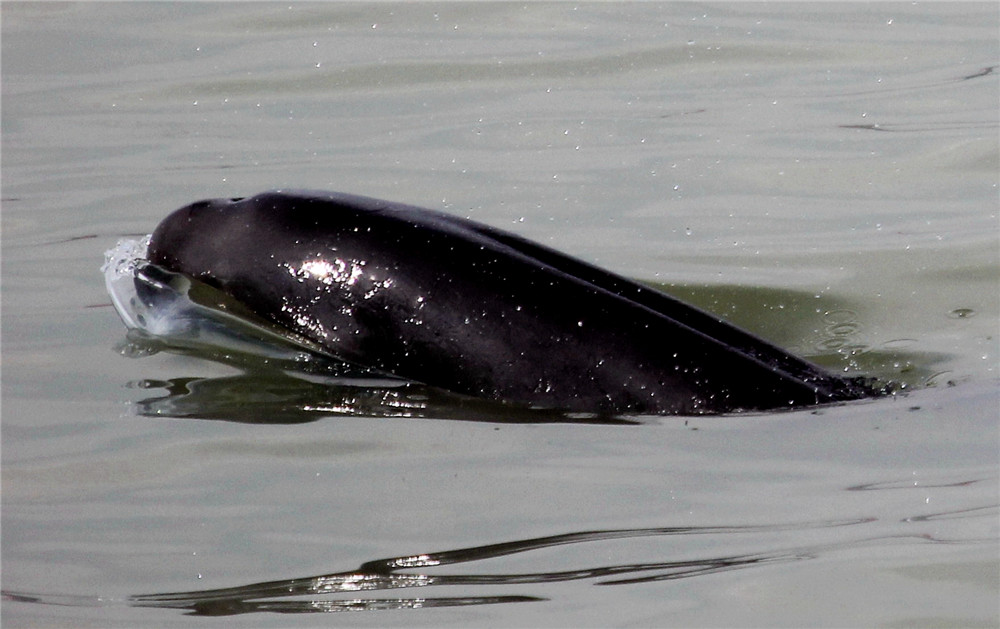
Dong Jiahe, director of the resources and environment department at the Jiangsu Ocean and Fisheries Bureau, blamed the decline in the numbers mainly on human activities, including water pollution, shipping industry development and overfishing.
Dong and his team took part in the survey by the Ministry of Agriculture and Rural Affairs and led investigative work on the Yangtze in Jiangsu.
"The species is still in extreme danger and human activities can hurt the mammal even further," he said. "More than 20 finless porpoises were found dead due to human activities in the first half of this year."
Yang Guang, a professor from the School of Life Sciences at Nanjing Normal University, said human activities pose most of the dangers faced by the mammals.
"Overfishing leads to food shortages for the porpoises. Construction along the river changes the topographic features and shrinks their habitat, while the propellers and noise from passing ships can cause accidental deaths."
Wang Shicheng, a member of the Nanjing Finless Porpoise Protection Association, said there are about 50 porpoises at the Nanjing Finless Porpoises Reserve, which was established in 2014 and covers 87 square kilometers.
"Nanjing is China's only city where these mammals can be observed in the downtown area. About 12 to 14 porpoises, divided into two groups, can regularly be seen near the Third Nanjing Yangtze River Bridge," he said.
"There were only about 20 finless porpoises in Nanjing several years ago," he said. "The city has established five observation stations to closely monitor and protect the porpoises. We want to know more about their behavior to draw up better protection plans."
According to the provincial ocean and fisheries bureau, the number of porpoises living in the Nanjing section of the Yangtze has risen notably.
During a 21-day, 2,000-km expedition on the river last year, researchers identified 321 finless porpoises, with some appearing repeatedly in the Nanjing section of the river.
The bureau also said that about 30 porpoises are living in the Yangzhou section of the Yangtze.
In July, the city formed the province's first porpoise patrol team.
The team consists of six members. The former professional fishermen have become full-time porpoise patrollers, and all live in Yanjiang Village near the Yangtze and know the area well.
Li, director of the finless porpoise protection association in Jiangdu, said this was one of the moves made by the ministry to switch from being an aquatic animal catcher to aquatic animal protector. It could also help to address a labor shortage in the fishery department and raise public awareness of animal protection.
Nanjing's Ocean and Fisheries Bureau has also hired some local fishermen to take part in porpoise observation work.
Yang, the Nanjing Normal University professor, said the increased attention paid by the government to porpoise protection, along with intensified measures, have improved the living environment for the species.
"To establish a better protection mechanism, Jiangsu province has drawn up a protection plan from 2016 to 2026 to stabilize the number of the porpoises in 10 years."
Liu Jun, deputy director of Nanjing Ocean and Fisheries Management Department, said the city government has also invested 20 million yuan ($2.9 million) to send various types of young fish into the Yangtze to restore the food chain by raising the fish population.
"We allocated 29.7 million yuan to buy 312 fishing boats, nets and other kinds of fishing gear from the fishermen," Liu said. "We arranged work for 128 fishermen and stopped them fishing near the Third Yangtze River Bridge in 2017."
Liu added that the city's public security and maritime departments have worked together to crack down on illegal fishing, and monitor parts of the Yangtze strictly to protect the porpoises.
"We have investigated more than 300 cases of illegal fishing and got rid of more than 5,000 illegal fishing items in four years.
"The government has made efforts to publicize the importance of porpoise protection," Liu said. "We often receive reports from locals who have witnessed illegal fishing that might endanger the porpoises."
The Ministry of Agriculture and Rural Affairs has helped to set up eight nature reserves for the porpoises along the Yangtze along with two large freshwater lakes.
The ministry is also working with the National Forestry and Grassland Administration on a proposal to the State Council, China's Cabinet, to upgrade the finless porpoise to a Category 1 species for national protection.
Guo Jun contributed to this story.





