



China's early rice yield drops amid structural reform









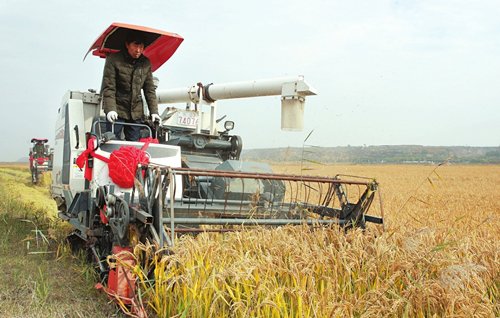
BEIJING -- China produced less rice in the first harvest period of the year compared to 2017 amid agricultural supply-side structural reform, official data showed Friday.
The country produced 28.59 million tonnes of "early rice," planted in spring and harvested in early summer. This was a decrease of more than 1 million tonnes, or 4.3 percent from a year earlier, according to the National Bureau of Statistics (NBS).
China's early rice planting area for the year stood at 4.79 million hectares, 6.8 percent less than last year, and yield per hectare grew 2.7 percent to 5.96 tonnes.
NBS statistician Hou Rui attributed the early rice yield drop to proactive changes in crop structure amid deepening agricultural supply-side structural reform, less rainfall, and crop rotation.
"It points to improved quality and efficiency of China's agricultural production," Hou said.
"The decline will have a very limited impact on the country's grain supply as early rice accounts for a small share of the annual grain output," Hou said.
Early rice is mainly planted in nine provincial-level regions: Zhejiang, Anhui, Fujian, Jiangxi, Hubei, Hunan, Guangdong, Guangxi, and Hainan.
Rice is a staple food in China, and its total grain output consists of three parts -- early rice, summer grain, and autumn production. Autumn grain crops, which include corn and middle- and late-season rice, account for the bulk of the grain production.


- China's second homegrown large cruise ship completes maiden sea trial
- Breathtaking views and smooth brews draw foreign fans to Yunnan coffee week
- Rain conjures ink-wash cloudscape over Hebei's Langya Mountain
- Robots transform Pudong airport expansion project
- Mainland welcomes Taiwan compatriots in joint space exploration: spokesman
- Chinese scientists develop novel method to differentiate neurodegenerative diseases





