



The facts and China's position on China-US trade friction









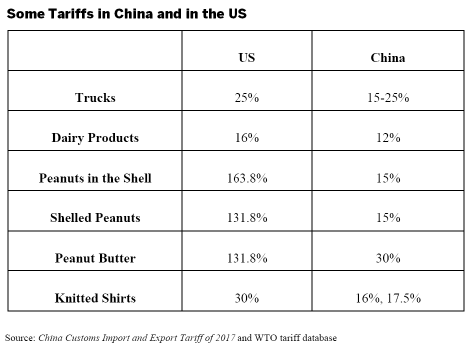
The reciprocity and mutual benefit principle advocated by the WTO means overall reciprocity and balance of interests in market opening across all the industries of the members, rather than narrowly defined reciprocity of treatment for a specific industry or product. Given the differences in endowment and competitiveness, absolutely reciprocal opening would be virtually impossible, and tariffs in different industries diverge. Even if we follow this absolute reciprocity logic of the US, unfair and non-reciprocal practices are more than common in the US. For exam ple, China's tariffs on peanuts in the shell, dairy products and trucks are 15%, 12% and 15-25% respectively, while WTO tariff figures show those of the US to be 163.8%, 16% and 25%, all higher than China. (Table 2)
China, having fulfilled its WTO commitments, has voluntarily engaged in unilateral tariff reductions to expand market opening. By 2010, all commitments in goods had been fulfilled, with the overall tariff level decreased from 15.3% in 2001 to 9.8%. Yet China did not limit itself to WTO commitments; it has promoted trade and investment liberalization through FTAs, given special treatment in tariffs to LDCs, and significantly reduced import tariffs using provisional tariffs on several occasions. According to the WTO, China's weighted tariff in 2015 had fallen to 4.4%, significantly lower than that of emerging economies and developing countries such as the Republic of Korea, India and Indonesia, approaching that of the US (2.4%) and the EU (3%). China's tariffs on agricultural products are lower than the real tariffs of Japan, and lower than those of Australia for non-agricultural goods (Table 3). From the beginning of 2018, China further voluntarily cut the MFN rate on whole vehicles to 15%, and the MFN rate on auto parts from a maximum 25% to 6%. China has reduced import tariffs for 1,449 daily necessities, with the MFN rate down by an average of 55.9% from 15.7% to 6.9%. Currently, China's overall tariff rate has been reduced to 8%.





