



Xuancheng and Huzhou sustain trade in calligraphy brushes









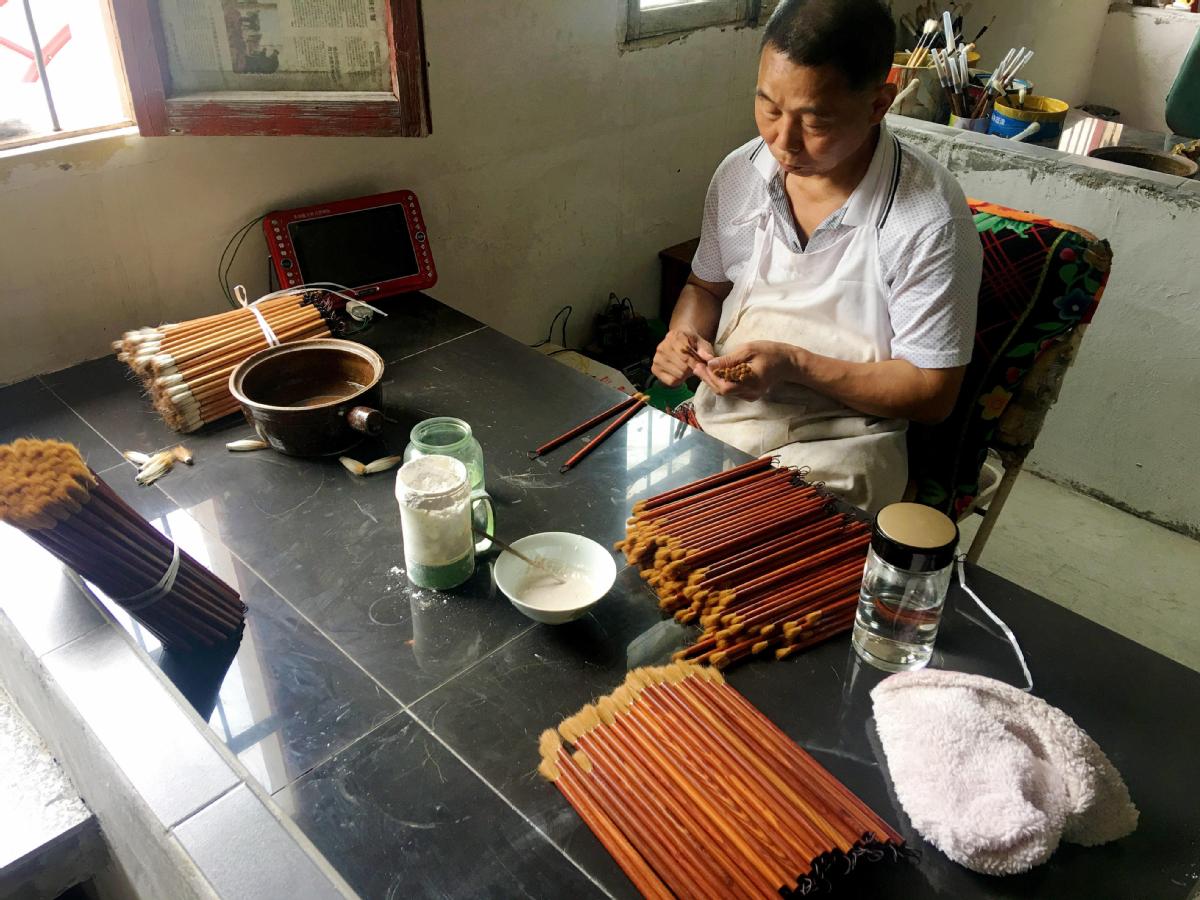
HEFEI - Sifting through bags of goat hair to select quality ones for the production of Chinese ink brushes can be tough and boring, but this is routine work for Zhang Wennian, 50, who is an inheritor of the traditional handicraft.
He said this is the first, the toughest and the most valuable part of the Chinese ink brush making process.
"The wool must be from the neck and underarms of white goats weighing under 25 kg. Only a small amount of goat hair is eligible enough for ink brushes - not too thick, not too soft," said Zhang, who inherited his family's ink brush making business from his father in 2009.
The ink brush, ink, Chinese Xuan paper and ink slabs are four traditional writing materials of Chinese stationery. The artistry of different types of Chinese calligraphy scripts as well as painting with traditional Chinese ink strokes require a variety of brushes.
With traditional ink brush making having a history of more than 2,000 years in China, Zhang said his family workshop produces brushes made with goat hair, weasel hair and rabbit hair.
To his pride, many famous contemporary Chinese calligraphers and painters, including Liu Haisu, Wu Zuoren and Ouyang Zhongshi, were fans of the brushes made by Zhang's ink brush workshop, which is based in the city of Xuancheng, East China's Anhui province.
In the workshop, where there is a strong odor of wool and lime water, Zhang always takes charge of screening raw materials.
Xuancheng, along with Huzhou in East China's Zhejiang province, are known as the places that produce the finest ink brushes in the country. Their brushes have earned a reputation as a local tribute to the imperial court and of being sought after by nobles and celebrities since ancient times.
Zhang said when his father managed the workshop, it was capable of producing more than 200 varieties of brushes with an annual output of hundreds of thousands in its heyday. The products were even exported to Japan and Southeast Asian countries.
"Nearly every household in Xikou town used to make ink brushes, but you can see few of them in the business these days. The neighbors have switched to other businesses, like running small supermarkets, farms or going to cities for migrant work," he said.
Traditional calligraphy with ink brushes has somewhat become exclusive to artists these days, and the younger generations are becoming more accustomed to e-reading and "paperless" writing, said Zhang.
The workshop now produces 100,000 ink brushes a year. And more than half of its annual revenue comes from small amounts of high-end products that are sold to artists, while school students are the main force of beginners learning calligraphy with cheap ink brushes, he said.
Owing to the falling demand, the supply of raw materials has fallen sharply, with Zhang finding it harder every year to purchase animal hair for his brushes.
However, Zhang is far from becoming pessimistic, as he has an insight into persevering in a shrinking industry.
"With a smaller market, we are forced to pursue quality, and it is important to carry on traditional handicraft and culture," Zhang said.
Indeed, and in 2003, the local government started developing a cultural tourism initiative that invites visitors to gain on-site experience of ink brush making tours, in an effort to both protect cultural heritage and boost the economy.
The traditional brush making technique was inscribed into China's "National List of Intangible Cultural Heritage" in 2008, while Zhang's workshop was chosen as a site to exemplify the art in 2011. Then, in 2012, he was selected as a national inheritor of the handicraft.
Zhang said he would soon get into the goat-breeding business, as it seems like a good way to secure a stable supply of quality wool.
Besides this routine work, he is also keeping records of historical documents concerning ink brush making, stories of veteran ink brush artists and his family business in the form of books, pictures and videos, so as to give tourists a more vivid and interesting cultural experience when visiting his workshop.
"The brush pen is the carrier that passes on Chinese culture. Maybe I can open a folk museum of ink brushes in the future," he said.











