


Category of site: Cultural Site
Brief introduction
The Mausoleum of the First Qin Emperor containing terracotta warriors and horses are located in Lintong county, near Xi'an city, capital of Shaanxi province. Constructed from 246 BC to 208 BC, the mausoleum was the first of its kind in Chinese history. With a height of 76 meters, the mausoleum is laid out in line with the dimensions of Xianyang, the capital of the Qin Dynasty. It is composed of the inner compound and the outer compound, which have perimeters of 2.5 km and 6.3 km, respectively. The tomb is located in the southwest of the inner compound.
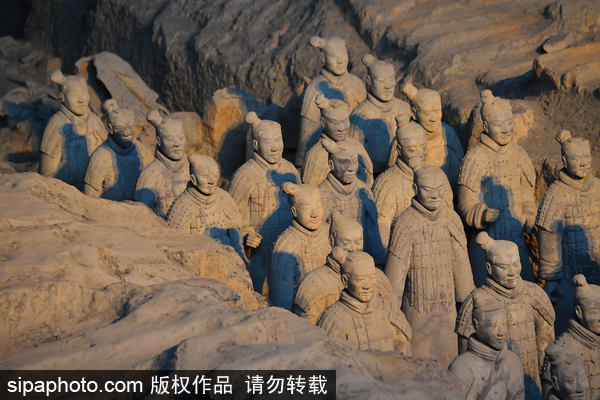
The pits containing the terracotta army guarding the mausoleum were discovered in 1974. Three pits have been excavated so far. Occupying an area of over 200,000 sq m, the three pits are arranged in a triangular shape, facing the east. A total of 8,000 life-size terracotta warriors, chariots and horses, and hundreds of bronze weapons have been excavated from the pits.
Two bronze carriages excavated from the west of mausoleum have four horses harnessed to each, and in each stand an official and a driver. They display an exquisite casting technique, and are regarded as bronze masterpieces and national treasures.
Continuing excavation of the mausoleum area promises to reveal more wonders in the years to come.
It was listed as a cultural heritage site by UNESCO in December, 1987.
Cultural heritage
The Qinshihuang Mausoleum is one of the world's largest imperial mausoleums. Although the actual tomb chamber has not been excavated yet, probes have determined that it is a luxurious underground palace with a unique structure and abundant funeral objects.
Many state leaders and experts worldwide believe that the discovery of the pits is a major archeological find and can be called the eighth wonder of the world, paralleling Egypt's pyramids. The excavated objects are precious material for the study of military science, politics, economy, culture, science and arts of the Qin Dynasty, over 2,000 years ago.
Due to their exceptional technical and artistic qualities, the terracotta warriors and horses, and the funerary carts in bronze are major works in the history of Chinese sculpture prior to the reign of the Han dynasty.
The terracotta warriors and horses represent a peak in the world's history of the art of pottery, adding glamour to China's civilization and the world's esthetics.
Bronze treasures
When arrows, spears, daggers and swords were excavated, it was hard to believe that they had been buried in damp soil for over 2,000 years.
These bronze weapons still glitter, and are so sharp that 19 layers of newspaper can be sliced through with them. Chemical tests indicate that all these weapons are made of bronze containing various other kinds of metals, and were processed to defy rust.
History
The mausoleum was originally called Lishan Hill. It was recorded that the mausoleum, covered by trees and grass, was 120 meters high and with the perimeter of 2,167 meters, looking like a real hill. However, since it was made of soil instead of stones, its height has been reduced to only 64.97 meters due to years of erosion and man-made damage.





