



China passes redrafted law to combat corruption









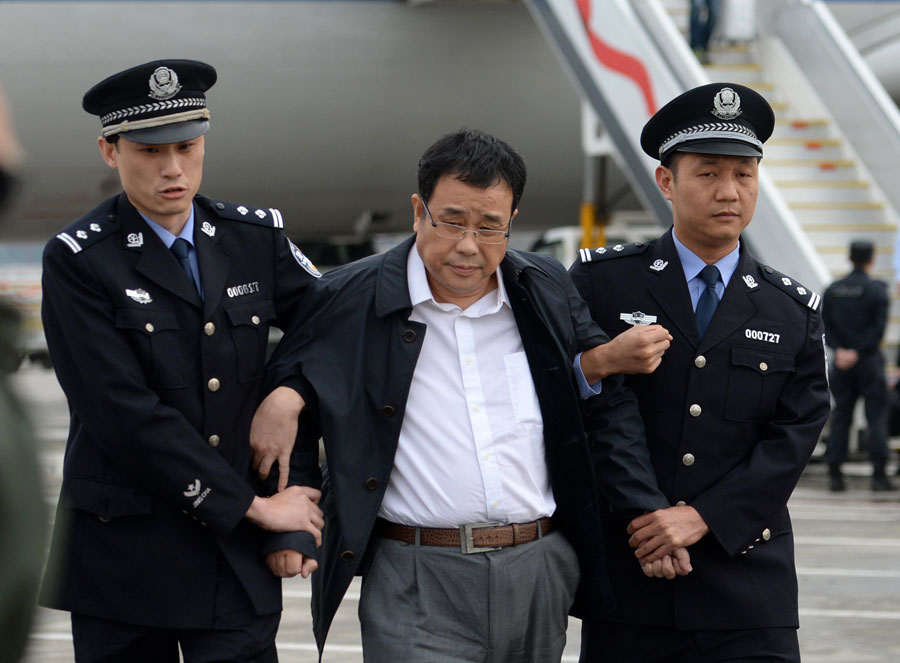
The amended regulation strengthens international judicial assistance and facilitates cross-border cooperation in the fight against economic fugitives on the run overseas. Zhang Yan reports.
"When I decided to return to China to plead guilty, I finally felt a sense of relief," said Li Huabo, one of China's most-wanted corrupt officials, who returned in 2015 after spending fours years on the run in Singapore.
In January last year, Li was given a life sentence by Shangrao Intermediate People's Court in Jiangxi province after being convicted of embezzlement, and 4.83 million yuan ($692,000), a small proportion of his ill-gotten gains, was returned to the State.
Li, 57, a former local government official from Poyang county in the eastern province, was accused of embezzling 94 million yuan in total.
"When I was hiding in Singapore, I gradually became anxious, self-doubting and timid due to nervousness and fear. I became unsociable and refused to communicate with other people," he said. "But my wife and daughter didn't give up on me, and consistently urged me to come back to face trial, then seek a lenient punishment."
He said his father and father-in-law both died while he was on the run. "As a son, I felt deeply sorry and ashamed because I couldn't look after them at the end of their lives," he said. "They always told me to be an honest, trustworthy person, but I betrayed their trust. Eventually, I showed remorse for my illegal acts."
Li fled to Singapore in 2011, after funneling 29 million yuan through banks in the city state. He obtained permanent residence in Singapore, but was later arrested by local police at a casino.
In July 2014, he was sentenced to 15 months in jail by a Singaporean court for "dishonestly accepting stolen property", and in May 2015, he returned to Beijing after serving 10 months of his sentence.
"Over the years since I fled, I have noticed progress in human rights in China, and improvements in the legal system," he said. "In particular, China launched the global Operation Skynet to hunt down fugitives. I could not expect to escape, so it was better to surrender."
Li was one of more than 4,000 fugitives accused of economic crimes, including 800 officials who have been brought back from more than 90 countries and regions to face trial since 2015.
In 2015, the Chinese authorities launched a special program to target fugitives on the run overseas and confiscate their ill-gotten assets.
"No matter where the fugitives escape to, we will make every effort to arrest them and bring them back to face justice," said La Yifan, director of the International Cooperation Bureau at the Central Commission for Discipline Inspection, the leading anti-corruption watchdog.
In recent years, a large number of corrupt officials or directors of State-owned companies have fled to destinations such as the United States, Canada, Australia or New Zealand to exploit a lack of bilateral extradition treaties or differences in the laws.
In addition, they have sent millions of yuan in illicit assets to banks overseas via illegal channels, such as money laundering or underground banks.
Between 2015 and October, 4,833 fugitives suspected of economic crimes were repatriated or persuaded by Chinese police to return from more than 90 countries and regions. Meanwhile, police confiscated 10.46 billion yuan in illicit assets held overseas, according to CCDI statistics.
The commission said more than 900 fugitives are still at large overseas, especially in Western countries, and it has ascertained the whereabouts of 360 of them.
Huang Feng, a professor of law at Beijing Normal University, said evidential materials are essential for detaining suspects and repatriating them to face trial.
"Chinese law enforcement officers face practical difficulties in providing foreign counterparts with sound evidential documents in places such as the US and Canada to form a 'complete chain of evidence'," he said.
This evidence, prepared to better meet the requirements of judicial procedures in foreign countries, is required to break a gridlock of legal technicalities considered to be the biggest obstacle to cooperation on law enforcement between China and other countries, he said.
Zhang Xiaoming, deputy director-general of the Department of Judicial Assistance and Foreign Affairs at the Ministry of Justice, said solid information is crucial to requesting assistance in law enforcement from other countries in "identifying, freezing and confiscating the illicit assets that have been sent abroad".
Zhang added that the information mainly includes proof of bribes accepted by officials who abused their power to obtain ill-gotten funds which were then transferred overseas illegally.


- Intl partnership targets poverty
- China's State Council sets up team to investigate Shanxi coal mine explosion
- Desert fighter, US friend to reunite soon
- Serbian president meets HBIS chief, backs green steel push in Belgrade
- Chinese-built cruise ship passes sea trials
- Senior Jiangxi official Li Wei investigated for discipline violations





