



Pollutants expected to linger through winter









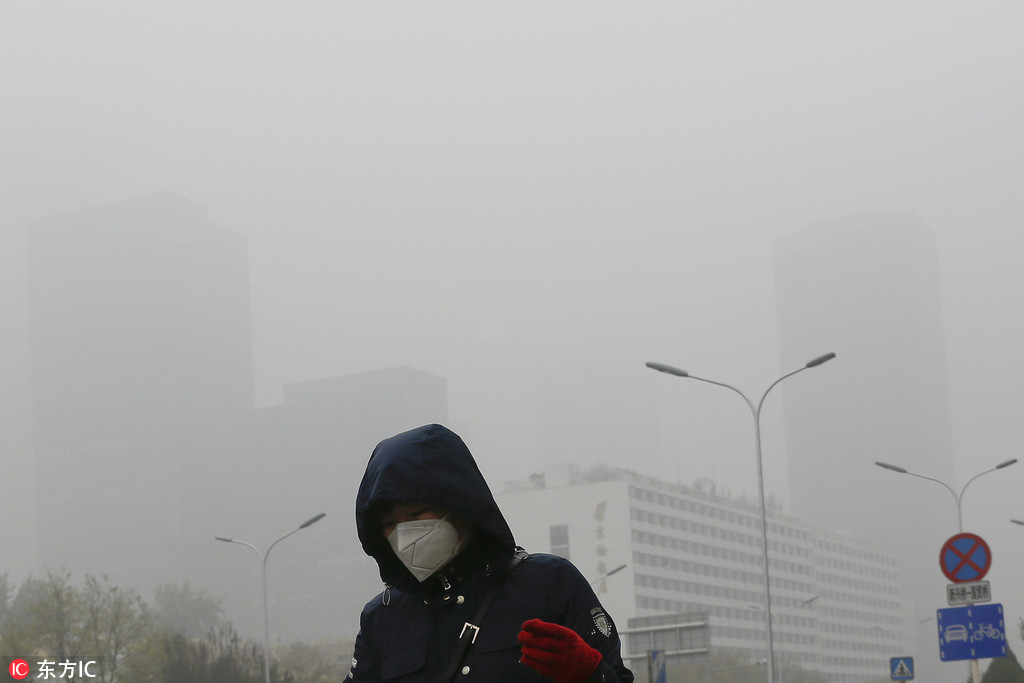
Meteorological conditions in northern China will generally be unfavorable for the dispersal of air pollutants until February, as the region enters the period that typically features the highest air pollution, authorities said.
The assessment by the National Climate Center and China National Environmental Monitoring Center was published on Thursday, as northern parts of the country officially started to supply heat to buildings.
Cold air movement from northern parts of the country are expected to be weak from December to February this winter, leading to calm air masses. That means air pollutants will be more difficult to disperse, according to a statement to media from the China Meteorological Administration, which oversees the National Climate Center.
Most parts of the country will experience a warmer winter than average, though there will be a comparatively colder start to the season, it said.
Precipitation will be unevenly distributed, with northern and southern China wetter than average. But central areas will see more dry weather, it said. "The eastern part of Northwest China and western parts of North China will see precipitation 20 to 50 percent less than average this coming winter," it said.
Without adequate precipitation, more dust is likely to be blown into the air, raising PM2.5 particulate concentrations.
Moreover, the use of coal to warm homes makes winter the season with the most air pollution in northern China.
He Kebin, dean of the School of Environment at Tsinghua University, said sulfur dioxide emissions were expected to increase by almost 50 percent in the Beijing-Tianjin-Hebei cluster after the start of heating season.
The cluster includes 28 major cities in Hebei, Shandong, Shanxi and Henan provinces as well as Beijing and Tianjin.
There will also be a 30 percent increase of PM2.5-fine particles that can enter the bloodstream-from emissions.
Even without the burning of coal for heating, the cluster is still one of the most heavily polluted regions, with a large concentration of industrial smokestacks for steel, construction materials and chemicals, and a dependence on diesel-powered trucks for transportation, said He, who is also a member of the Chinese Academy of Engineering.


- Mainland slams DPP's sustained separatist agenda
- Robots expanding limits of mega projects
- Intl partnership targets poverty
- China's State Council sets up team to investigate Shanxi coal mine explosion
- Desert fighter, US friend to reunite soon
- Serbian president meets HBIS chief, backs green steel push in Belgrade





