



Philippines trip bolsters bilateral ties









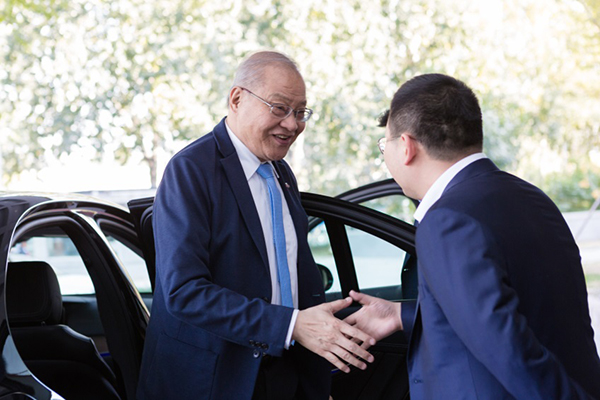
President's arrival marks milestone, heralds new chapter for relations
President Xi Jinping's state visit to the Philippines on Tuesday and Wednesday marks a milestone in relations between the two countries, and will herald a new chapter for bilateral ties, said the Philippines Ambassador to China Jose Santiago L. Sta. Romana.
Xi's trip is the first state visit of a Chinese president to the Southeast Asian country since 2005. His last trip to the Philippines was in November 2015 to attend the APEC leaders' meeting.
The visit will push forward the positive trajectory of relations following Philippines President Rodrigo Duterte's state visit to China in October 2016, Sta. Romana said in an exclusive interview with China Daily.
"High-level exchanges serve as a compass, a guide for the two governments," Sta. Romana said. "There are challenges that still remain, but the basic thinking on the part of Duterte is to do business with China and have harmonious, friendly relations."
Sino-Philippine ties soured amid maritime disputes in the South China Sea, but began improving after Duterte became president in June 2016.
"We basically have an understanding that whatever differences we have should not be obstacles to promoting bilateral ties," Sta. Romana said, adding that managing differences and finding areas of cooperation are key to the rapid progress the countries have made in the past two years.
In terms of current bilateral relations, Sta. Romana said Manila is very satisfied with the situation.
"We follow the dual-track approach," he said. "We put the contentious issues on one track and put the noncontentious issues on another track. We fast track the noncontentious areas-like trade, economics, investment, science, culture and education-where the two sides can progress in a mutually beneficial way."
As for the contentious issues, Sta. Romana said there are areas where the countries don't see eye to eye, but they can discuss them frankly and in a friendly way through a bilateral consultative mechanism.
He added that what drives bilateral ties forward are three pillars: economic cooperation, combating illegal drugs and terrorism, and people-to-people exchanges.
Bilateral trade reached $51.3 billion in 2017, an increase of 8.5 percent over the previous year.
Sta. Romana said despite many challenges, the two sides have to promote ties with more determination. "The benefits of our bilateral relations will be felt by broader sectors in society. We should make them sustainable because it is our goal to have cooperation for peace, stability and development."
The Philippines assumed the role of country coordinator of relations between China and the Association of Southeast Asian Nations in August.
ASEAN and China are currently negotiating the Code of Conduct in the South China Sea.
Sta. Romana said his country hopes that during its two years as coordinator, various parties will be able to achieve a consensus and present an effective, binding code of conduct that helps ease tensions, manage disputes and explore areas of cooperation.
Speaking of some countries outside ASEAN attempting to complicate the South China Sea issue, Sta. Romana said ASEAN's position is very clear. "We want a region including the South China Sea to be free of big powers' rivalries. We don't wish to see the deployment of modern and advanced weapons in the area, and we hope we can maintain a zone of peace, stability and friendship."
Sta. Romana praised the China-proposed Belt and Road Initiative, saying the initiative converges with the Philippines' development priorities, and also with ASEAN's master plan of connectivity.
"In the Philippines, it not only promotes connectivity, but also promotes people-to-people links," he said. "We are part of the BRI, because there are areas of cooperation beneficial not only to China, but also to the Philippines and Southeast Asia."
Sta. Romana-a China expert due to his almost 40 years of living and working in China as a student and then a veteran journalist-h(huán)as been a diplomat since 1971. He lauded China's tremendous achievements since its reform and opening-up in 1978.
"The key, I think, is how to make sure the China dream is shared by not only neighboring countries, but also the international community," he said.










