



Duisburg revives on Chinese rail freight









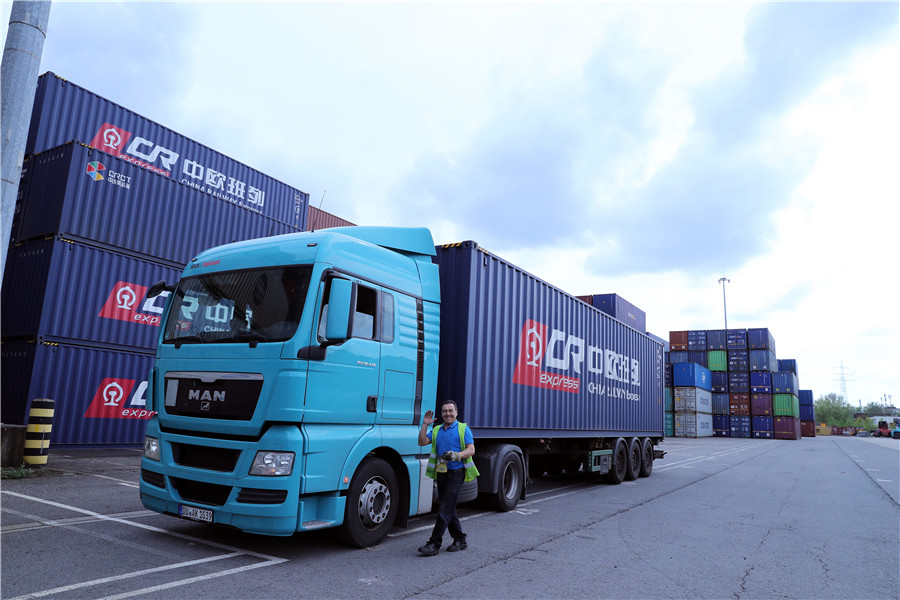
DUISBURG, Germany - For decades, the city of Duisburg lying at the heartland of Germany's industrial Ruhr region, had struggled with a depression just like other heavy industry cities around the world that were experiencing a structural transformation.
But nowadays the world's biggest inland port is changing - the sites once used as steel mills have been turned into transport terminals. Trucks come and go around the cities and crane operators unload containers from freight trains and pile them up one above another.
"The freight services from China are really important for us," said Amelie Erxleben, a staff member with the Duisburg Intermodal Terminal, the biggest of the nine terminals of the Port of Duisburg.
As Duisburg is ambitious to become the hub of logistics in the center of West Europe, it is grasping a chance for revival as China is to revive the ancient Silk Road.
"Take a look around, Chinese containers are everywhere here," said George, a 58-year-old German truck driver, pointing at a container nearby with a logo CRE, which is short for China Railway Express. He is among hundreds of drivers waiting at the DIT for a freighter order.
CRE is the railway freight service linking China and Europe. According to China Railway Corporation, in the first half of this year, the service has linked 48 Chinese cities with 42 cities in 14 European states and 2,497 trains traveled the route, a 69-percent rise compared with the same period of last year.
George said CRE trains have brought significantly more Chinese businesses to the terminals and Port of Duisburg. The products are no longer silk, tea or ceramics. Made-in-China laptops, mobile phones and textiles are the most popular products reaching Europe onboard the train, while made-in-Europe high value-added fine wines and vehicle spare parts are shipped to China.
Erxleben said now 25 freight trains travel every week between Chinese cities and Duisburg, 15 China-bound and 10 Europe-bound, accounting for nearly one-third of the freight volumes of the DIT.
"All that starts here!" said Erxleben, standing at the end of the railway at the DIT. That afternoon, another cross-continental freight train arrived, and three cranes unloaded containers and transfered them through the Rhine River or trucks to other European cities.
But four years ago, only two or three freight trains traveled between China and Duisburg.
Owing to the surge in freight volumes, the terminal became narrow and busy. About 600 to 800 trucks come and go every day, and the terminal expanded its truck fleet from 10 several years ago to 60 now. The terminal has also bought 200,000 square meters to store more containers.
Johannes Pflug, who is responsible for China affairs in the Duisburg municipality, said that over 6,000 jobs have been created by CRE.
Markus Taube, an economist with the University of Duisburg-Essen, has intensively studied the Silk Road and found that the city benefits from the initiative.
"We've been able to show that investments have been made, that jobs have been created, in the context of this Silk Road Initiative (the Belt and Road Initiative), which means we talk about more than just containers arriving in Duisburg and then being shipped here. There is a small industry around it, which generates tax revenue for the city, creates jobs and strengthens the reputation and importance of the city," Taube told the Deutschlandfunk earlier this year.
Duisburg has gained significant publicity in recent years, attracting journalists from nearly all parts of the world. Soeren Link, mayor of Duisburg, even said the city is the "China Town" in Germany.
The cargo service is widely referred to as a key project within the framework of the Belt and Road Initiative, which was put forward by China in 2013 to boost connectivity and seek common prosperity.











