


Category of site: Cultural site
Brief introduction
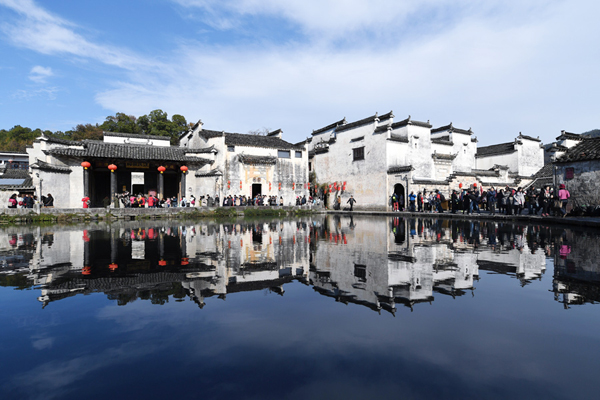
Located in Yi county, Huangshan city in south Anhui province, the two traditional villages Xidi and Hongcun are architectural complexes, with a high historical and artistic value. The overall layout, landscape, architectural form, decoration and construction techniques all retain the original features of Anhui villages between the 14th and 20th centuries.
Xidi village proper is composed of more than 300 civil residences, most of which were built in the Ming and Qing dynasties. Backed by picturesque hills and towering ancient woods, this village is noted for the harmony of its architecture and its colorful fields. The residential buildings are mostly black and white. The decorations display a strong flavor of the Ming and Qing dynasties. In the houses, there are collections of precious calligraphy and handicrafts. Potted plants, fishing pools and flowerbeds give the whole village a sense of harmony with nature and manmade culture.
Hongcun village is most noted for its overall design that resembles the shape of an ox. Principal Street connects the South Lake and the Moon Pond to the north and south, respectively. The ancient Academy of the South Lake (Nanhu Shuyuan) casts its shadow in the lake and creates a tranquil scene together with ancient trees and graceful buildings around it.
They were added to the World Cultural Heritage List in 2000.
Cultural heritage
Xidi and Hongcun experienced 1,000 years of continuous transformation and development, all the while authentically preserving their characters as traditional Chinese villages with commercial economies and clan-based social structures. The villages faithfully preserve elements that are typical of traditional pre-modern villages, including the surrounding environment, manmade waterways, the villages' layout, architectural style, decorative arts, construction methods and materials, traditional technology and the overall appearance of the villages. Additionally, the site preserves regional art, customs, cuisine and other forms of cultural and traditional ways of life. Xidi and Hongcun are, without a doubt, ideal sites for a contemporary society to seek its history, and to research traditional village culture.
Yi county, to the southwest of Huangshan Mountain, dates back from the Qin Dynasty. Over more than two millennia, it has enjoyed peace, and kept its original flavor of natural beauty and cultural creativity. It was once called the source of the plum-blossoms (Tao Hua Yuan), a much-quoted term for a secluded paradise in Chinese literature. The great Tang Dynasty poet Li Bai also wrote a poem praising it.
The inhabitants, originally people of the State of Yue, are renowned for their sense of independence and respect for culture and tradition.
Thanks to such traits and centuries of earnest efforts, about 3,000 buildings survive intact from the Ming and Qing dynasties. Even the smallest details of the domestic decorations are now incarnations of the time-honored civilization of China.
Architecture and landscape
A typical traditional residence of southern Anhui province is usually divided into three parts. With an ingenious arrangement, the whole space looks unified and neat, as well as flexible and lively. Rooms were usually built symmetrically, with the main halls in the middle, flanked by side halls. Stairs were installed in the main hall, and an indoor skylight was made near the entrance for lighting and ventilation.
The roofs of the rural buildings are basically shaped like upturned half-opened books, with raised beams or gable roofs. The outside wall is covered with black tiles in rippling or curling shapes, dotted with only small yet well-decorated windows. The main gate, framed in local blocks, usually has a richly-decorated door casing made of stones or bricks.
Most of the family gardens are built in the front of the courtyard, while some are beside or behind the building. Small as these gardens are, they are designed with great originality and embody a profound poetic quality. The space is often divided, transformed and re-organized by hollowed windows, doors, screens, flowers or plants, giving an intricate sense of refreshment.





