



Tree coverage takes big strides in north









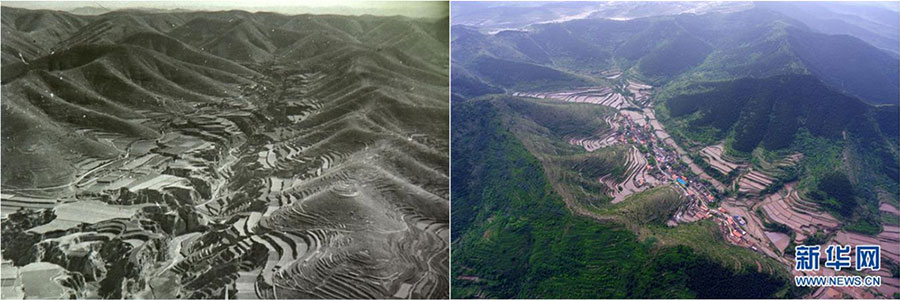
China's efforts to fight desertification in northern China have made major strides over the past 40 years, but challenges remain, according to an evaluation report by the Chinese Academy of Sciences.
The Three-North Shelter Forest Program, launched in 1978, is aimed at planting trees across more than 400 million hectares in 13 provinces in northern China by 2050.
According to a report released at a news conference in Beijing on Monday by the academy, which was invited by the National Forestry and Grassland Administration to evaluate the program's achievements as a third party, an accumulated area of 46 million hectares of forest has been planted in the Three-North areas-North, Northeast and Northwest China-over the past 40 years at a total cost of 93.3 billion yuan ($13.5 billion).
Forest coverage in the Three-North areas had reached 13.5 percent as of 2017, up from 5.05 percent in 1978.
The program has started to "curb desertification" since 2000, which is "especially obvious" in key areas such as the Horqin Desert and the Mu Us Desert, according to the report.
Planting helped increase the area of windbreaks by 154 percent over the past 40 years. Meanwhile, the program has helped reduce the area of soil erosion by 67 percent.
The program also helped local farmers increase income. Fruit production from these forests has increased 30 times over the four decades, providing farm jobs to 313 million people, it said.
Under the administration's plan, China will increase tree coverage by 3.33 million hectares per year to further combat desertification.
But Zhang Yaping, vice-president of the Chinese Academy of Sciences, said challenges remain, including a low survival rate of trees and lack of water.
Previous planning failed to take into consideration whether local water resources could support the large-scale planting, and the lack of management after trees were planted also caused a decline in the forest, he said.
The academy found that an average of only 47 percent of the trees survived.
Liu Dongsheng, deputy director of the National Forestry and Grassland Administration, said at a news conference: "What's been done in the past 40 years are the easy jobs, and what's left with us are the more thorny problems."
Such problems include growing forest in areas naturally hostile to trees, he said.
"Costs of greening also rise because water resources become scarcer and tree saplings are more expensive," he added.
The academy suggested in the report that efforts should be made to optimize the existing program plan by taking into consideration actual demands and the carrying capacity of water resources.


- Mainland slams DPP's sustained separatist agenda
- Robots expanding limits of mega projects
- Intl partnership targets poverty
- China's State Council sets up team to investigate Shanxi coal mine explosion
- Desert fighter, US friend to reunite soon
- Serbian president meets HBIS chief, backs green steel push in Belgrade





