



Preservation of Tibetan culture linked to its modern development: China Daily editorial









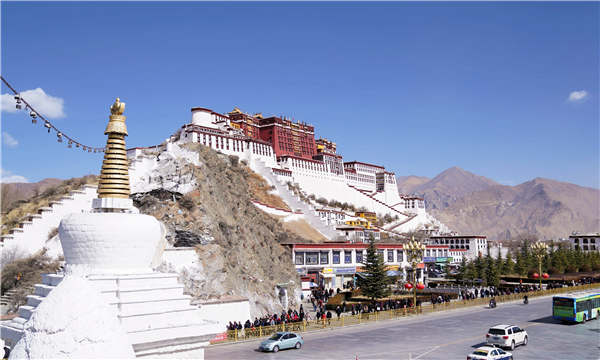
Should the Tibetan autonomous region open up to the outside world?
With China increasingly integrated with the world, which is itself increasingly globalized, this should not be a question. Yet the preservation of Tibetan culture including its local language is often used as an excuse by some in the West to deny Tibetans the right to economic growth and better lives.
Their desire to keep Tibetan culture preserved in aspic does a disservice to the Tibetan people, who, like their counterparts elsewhere, have the right to higher living standards that can only be obtained through local economic development. That explains why the work report the government of the Tibet autonomous region delivered to the local people's congress on Thursday makes it imperative for Tibet to open wider to the outside world.
By better cooperating with provinces and cities elsewhere in the country and further opening up to the outside world through cooperation with Belt and Road countries, the autonomous region would be able to attract more investment and maintain the momentum of its rapid economic growth.
Tibet would not have achieved the 10 percent of economic growth in 2018 without its cooperation with other provinces and cities, and without the 49 billion yuan ($7.19 billion) tourism revenue, an increase of 31.5 percent over that of 2017.
As far as the development of Tibet is concerned, how to achieve a balance between the preservation of its traditional Tibetan culture and improving the living standards of local Tibetans through rapid economic growth is always a concern.
But preservation of traditional Tibetan culture should not mean keeping the region underdeveloped forever and neither should it mean denying Tibetans access to higher living standards and a modern lifestyle.
Without economic growth, Tibet would have no money to preserve its ancient lamaseries and it would be unable to provide for those lamas living in the lamaseries. Without increased revenue, Tibet would not have money to protect its natural environment.
The local government invested 10.7 billion yuan in improving and protecting the local environment by planting trees on the vast plateau in 2018. It has also established several State-level nature reserves to protect the local environment.
Tibetan culture is not frozen in time. Like any living culture, the traditional culture of Tibet has been handed down from generation to generation, and the legacy of the past is now part of modern Tibetan culture, which is oriented toward the future and the rest of the world. A culture can only remain vital by keeping up with the times, otherwise, as some in the West seem to want for Tibet, it becomes merely a curiosity show of how people lived in the past.





