


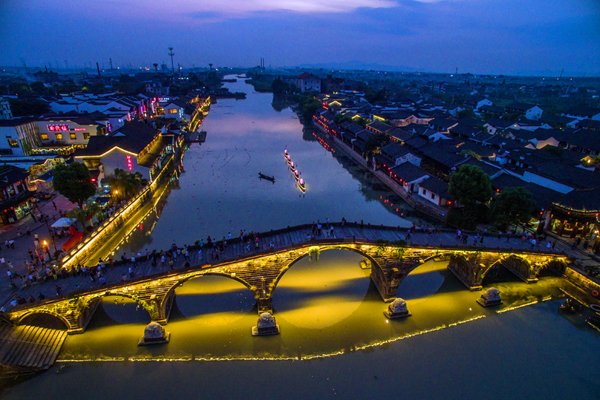
Category of site: Cultural site
Brief introduction
As the world's longest man-made canal, the Grand Canal is a vast waterway system in the north-eastern and central-eastern plains of China, running from Beijing in the north to Zhejiang province in the south.
The Grand Canal is one of the greatest hydraulic projects in human history, stretching 1,794 kilometers. Constructed in sections from the 5th century AD onwards, it was conceived as a unified means of communication for the Empire for the first time in the Sui Dynasty (7th century AD). By the 13th century it consisted of more than 2,000 km of artificial waterways, linking five of China's main river basins.
The canal was a pillar for the economy, social stability and government functions in ancient China. It also helped the evolution of Chinese culture by enhancing communication between the south and the north.
It was added to the list on June 22, 2014.
History
The Grand Canal forms a vast inland waterway system in the north-eastern and central eastern plains of China, passing through eight of the country's present-day provinces. Constructed in sections from the 5th century BC onwards, it was conceived as a unified means of communication for the Empire for the first time in the 7th century AD (Sui Dynasty).
The record of canal excavation was dated back to the Spring and Autumn Period or earlier. The development of canal reached its peak in the Sui Dynasty. Before foundation of Sui Dynasty, China had successively excavated several ditches and canals, many of which had been silted up or suspended due to transition of natural environment. Some needed to be dredged but were still navigable, but were too separated from each other to form large-scale water transport nationwide.
The establishment of Sui Dynasty declared the end of long-lasting split situation. In 605 AD, Emperor Yang Guang, the second emperor of Sui Dynasty, ordered excavation of the Grand Canal to meet the political, economic and military needs of unified nation. In 611 AD, the Grand Canal was completed and became the main transport artery between south and north China.
This led to a series of gigantic worksites, creating the world's largest and most extensive civil engineering project ensemble prior to the Industrial Revolution.
The Grand Canal reached a new peak in the Yuan Dynasty (13th century), providing a unified inland navigation network consisting of more than 2,000 km of artificial waterways, linking five of the most important river basins in China, including the Yellow River and the Yangtze.
Still a major means of internal communication today, it has played an important role in ensuring the economic prosperity and stability of China over the ages.
Cultural heritage
The Grand Canal represents the greatest masterpiece of hydraulic engineering in the history of mankind, because of its very ancient origins and its vast scale, along with its continuous development and its adaptation to circumstances down the ages. It provides tangible proof of human wisdom, determination and courage. It is an outstanding example of human creativity, demonstrating technical capabilities and a mastery of hydrology in a vast agricultural empire that stems directly from Ancient China.
It bears witness to the unique cultural tradition of canal management via the Caoyun system, its genesis, its flourishing, and its adaptations to the various dynasties and their successive capitals, and then its disappearance in the 20th century. It consisted of an imperial monopoly of the transport and storage of grain, salt and iron, and a taxation system. It contributed to the fundamental link between the peasant economy, the imperial court and the supply of food to the population and troops. It was a factor of stability for the Chinese Empire down the ages. The economic and urban development along the course of the Grand Canal bears witness to the functioning core of a great agricultural civilization, and to the decisive role played in this respect by the development of waterway networks.
The Grand Canal is a benchmark in terms of dealing with difficult natural conditions, as is reflected in the many constructions that are fully adapted to the diversity and complexity of circumstances. It fully demonstrates the technical capabilities of Eastern civilizations. The Grand Canal includes important, innovative and particularly early examples of hydraulic techniques. It also bears witness to specific know-how in the construction of dykes, weirs and bridges, and to the original and sophisticated use of materials, such as stone and rammed-earth, and the use of mixed materials (such as clay and straw).





