


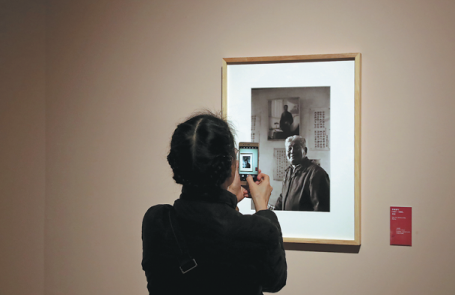
"He didn't photograph people who sat there waiting for the photo to be taken. Rather he would wait until people moved, then picture them going about their business. He liked that feeling."
One portrait on show, taken by Zhou Haiying in 1949, depicts a street vendor selling prepared food in an alley of Shanghai. As he was framing the shot, the man walked toward the camera in a lighthearted manner and with a triumphant grin. It is reminiscent of French photographer Henri Cartier-Bresson's iconic photo taken in 1954, Rue Mouffetard, Paris, in which a boy is pictured carrying two bottles with the same exuberance.
Zhou Haiying attributed his concern for the commoner, their joy and agony, to Lu Xun - who expressed similar feelings in his writing. "His care for those at the bottom of society ... exerted a deep influence on me. It was my father who taught me how to take photos."
Being the son of Lu Xun allowed Zhou Haiying frequent contact with many social and cultural figures. He also took portraits of them. His pictures, like the work of 17th-century Dutch painter, Rembrandt, have a similar approach to reinforcing the contrast between light and shadow. His lens retains a stillness of time, bringing those historic figures back to life which, in return, adds levels of depth to his work.
Zhou Haiying's given name, literally meaning "infant of Shanghai", marks the city in which he was raised, although he moved to Beijing to attend university and remained in the capital until his death in 2011. Some of his photos provide a snapshot of similarities and distinctions between the two cities - both in landscape and people's livelihoods - in the 1940s and 1950s.
The exhibition includes two wedding photos he took, one in Shanghai and one in Beijing, in 1950.
The former shows a middle-class wedding taking place at a church decorated with a lot of floral bouquets. The bride and groom, dressed in Western-style outfits, walk down the aisle, watched by a crowd of guests.
Conversely, the latter shows a newlywed couple standing in a traditional siheyuan courtyard of Beijing. Their clothes are austere and of the same style, and they were both pictured wearing a big flower on their chest.
Zhou Lingfei recalls that when his father neared 80, he wanted to buy a digital camera.
"I said a digital camera was too heavy to carry around for a man of his age, let alone changing lenses and that sort of thing, but he insisted, saying photography was the love of his life.
"Father said one should develop an interest in one thing, take it seriously, and stick to it throughout one's lifetime. I miss him."





