



High-five for sky Wi-Fi









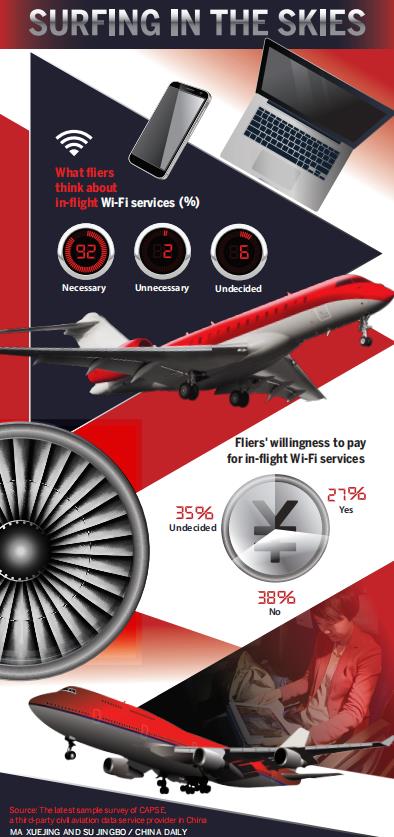
"The Chinese civil aviation market will continue to grow remarkably. Starting last year, domestic passengers were allowed to use portable electronic devices during flights (after the regulator-the Civil Aviation Administration of China-eased certain restrictions in January 2018)," said Zhang Chi, deputy general manager of China Eastern's e-commerce unit.
Globally, many airlines now offer in-flight Wi-Fi services, covering 39 percent of available seat miles or ASM. The United States offers the widest Wi-Fi penetration-71 percent of its airlines' seat capacity is covered.
Among non-US airlines, only 13 percent of seat capacity has Wi-Fi access, according to New York-based Routehappy Inc, an air travel information platform.
"The next three years would be a period of infrastructure-building for domestic in-flight Wi-Fi coverage. The operational costs are also expected to be lowered, with the maturing of technologies and the introduction of more related policies," Zhang said.
"The rapidly growing number of internet users and the data that each consumer uses daily, as well as the dropping costs of data, will be a catalyst for the fast development of the mobile internet market."
By 2035, connected aircraft will become universal, and the global market is forecast to be worth $130 billion, which will benefit airlines, hardware manufacturers, content providers, retailers and advertisers, according to a research report by Inmarsat and the London School of Economics and Political Science.
"Air travel has never been such a good deal for consumers. Not only are fares staying low, the options for travelers are expanding. Some 1,300 new direct links between cities were opened in 2018, and 250 million more journeys by air occurred in 2018 than in 2017," said Alexandre de Juniac, director-general and CEO of the International Air Transport Association.
In addition to wider internet coverage during flights, other aspects of air travel, starting from check-in to boarding, are getting digitalized in China.
In January, China Southern started online seat selection for all domestic flights and paperless e-boarding passes, lending a green touch to travel.
In late January, its first week of digitalized operations saw around 75 percent of domestic passengers selecting their seats via digital devices. Last year, the carrier transported 139 million passengers.
"The global aviation industry is at a crucial development stage. It is shifting from an increment-driven market to one in which greater value and opportunities are extracted from the existing market. Digitalization presents a significant opportunity for the China market," said Yu Zhanfu, partner and vice-president of the China practice at Roland Berger consultancy.
From February, Shanghai Pudong International Airport upgraded its free Wi-Fi services on its premises. Passengers can use airport Wi-Fi for free for three months from the date of authenticating their registration on the network. The airport's internet access is 20 times faster than before, and stable, according to the Shanghai Airport Authority.
Passengers can download large files like entertainment content quickly. Some 50,000 connections can be used at the same time on their premises, airport officials said.
Meanwhile, Guangzhou Baiyun International Airport, one of the major international travel hubs in China, has been transforming itself into a smart facility.
By the end of last year, Baiyun airport had 234 self-operated check-in machines. Nearly 70 percent of the passengers opted to use them, airport officials said.
Besides, Terminal 2 of the Baiyun airport had 55 self-service baggage checking machines, the highest for any domestic airport. This has helped shorten the waiting time for passengers and boosted operational efficiency, they said.
Also, Baiyun airport has become the first domestic airport to start self-service boarding. As of December, it had 45 self-service boarding gates, and passengers can pass through these using the facial recognition technology.
That's not all. Baiyun airport had 75 self-service passageways at the border exit and entry areas. In the last two years, the number of travelers who used self-service customs clearance surged more than 60 percent annually, airport officials said.
The airport said in a statement it plans to further improve paperless operations, and the self-help services that can cover the whole process. It will also strengthen the application of technologies like biometric recognition, augmented reality, and artificial intelligence for a smarter ecologic system, to cover all airport services.











